An article in the New York Times on Memorial Day cautioned people about walking barefoot in the park. It seems there are dangers lurking in the grass. You might get tetanus from stepping on a rusty nail; you might stub your toe on a rock. From wet grass, you could pick up the fungus that causes athlete's foot or the virus that leads to plantar's warts or the bacteria that causes stinky feet. A dermatologist noted, "When you go barefoot, you are exposing yourself beyond what you really need to.” The solution: wear shoes or flip-flops and put down a blanket over the grass. Or, you could just not go outdoors.
When Fred was a boy growing up in Wisconsin, he loved to wander in the woods. He would find a favorite tree and perch for hours taking in the sun, feeling the sway of the branches in the breeze, and letting his mind drift.
Mary Ann and her sister spent many a summer afternoon riding their bikes out into the countryside around their town in South Dakota, stopping to admire the flowers along the roadside or to sit by a stream watching the water ripple over the rocks. In his autobiography Returning, novelist Dan Wakefield captures what we knew as children: "In the fields and woods not far from my house, I felt close to the source and mystery of things."
But many of today's children have little or no direct contact with nature. In Last Child in the Woods: Saving Our Children from Nature-Deficit Disorder (an updated and expanded paperback edition has just been released), journalist and child advocacy expert Richard Louv describes the dire effects of separation from the natural world, including a diminished use of the senses, attention problems, and increased emotional and physical diseases. The author spent ten years traveling around the country talking to parents and children, college students, teachers, scientists, religious leaders, child-development researchers, and environmentalists.
"Nature-deficit disorder" is not a medical condition but a description of the human toll when children are cut off from nature. It seems to us to be a far more serious condition than the skin problems associated with going barefoot in the park.
How did it happen? Louv points to the proliferation of technology; cable TV, video games, home computers, and the Internet have all cut into the time children could have spent outdoors. In one interview a fourth grader in San Diego said: "I like to play indoors 'cause that's where all the outlets are."
Further, Louv notes, the media, schools, families, and the regulatory structures of many neighborhoods have "scared children straight out of the woods and fields." The culture now favors organized sports over unsupervised play in nature. In a 1991 study, researchers found that the radius children were allowed to roam outside their homes decreased to a ninth of what it was 20 years ago.
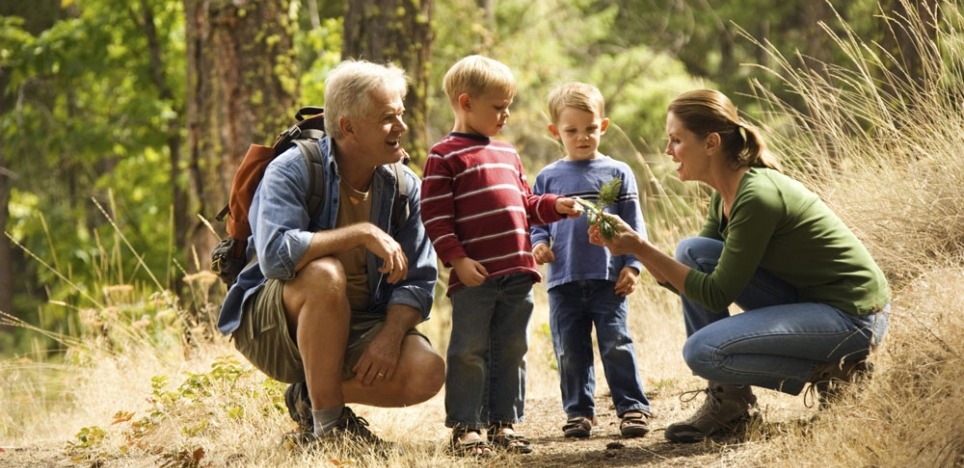
Summer is fast approaching. Now is the time to go against this cultural trend and give the children in your life (including your inner child) a true experience of nature — and the manifold spiritual messages to be discovered outdoors. In The Sermon of All Creation: Christians on Nature, we find these words from Protestant theologian John Calvin (1509-1564): "The creation is quite like a spacious and splendid house, provided and filled with the most exquisite and at the same time the most abundant furnishings. Everything in it tells us of God." And this is from Paul of the Cross (1694-1775): "Listen to the sermon preached to you by the flowers, the trees, the shrubs, the sky and the whole world. Notice how they preach to you a sermon full of love, of praise to God, and how they invite you to glorify the sublimity of that sovereign Artist who has given them being." In Awake in the Wild, Buddhist Mark Coleman writes, "In nature we can feel a living connection with life all around us. Being outdoors we can taste how we are held and nourished exquisitely by the intricate web of life that is supporting us in every moment, every breath."
Here are three simple practices to combat nature-deficit disorder:
- Make a habit (say, three times a week) of going outdoors to watch the sunrise or the sunset. Reflect upon how the light of God shines in your life.
- Go for a hike in the woods or for a walk in a wooded park. Take your time. Notice the shapes of rocks, the variety of little life on the ground, the birds' songs, the different kinds of bark on the trees, the way moisture collects in certain spots. Bring the experience home with you by drawing something you saw or making up a story with characters you met in the woods.
- Get away from the city lights at night and look up. The summer sky is spectacularly crowded with stars. Imagine how the moon sees our world, an exercise that teaches the unity of all God's creation.
Another way to really get into the spiritual teachings of nature is to take our e-course on Practicing Spirituality in Nature. You'll receive via email 40 days-worth of quotes and practice suggestions to enrich your experiences outdoors any time of year. Find out what prompted Henry David Thoreau to proclaim "My profession is always to be alert, to find God in nature, to know God’s lurking places, to attend to all the oratorios and the operas in nature."
The e-course is available on-demand so you choose your own start date and frequency.