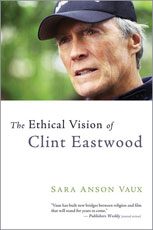
"Eastwood is full of surprises. His movies quietly but insistently invite meditation on human nature, history, and ethics — the strange ways that human beings organize themselves into social and political groups or divide themselves from the people and forces they fear. He explores the ways they polarize and publicize and distort truth and exclude those who are not rich, beautiful, or ruthless enough to ascend to power," writes Sara Anson Vaux, who is director of the Office of Fellowships at Northwestern University where she also teaches film in the religious studies department. She is the author of Finding Meaning in Movies.
In this scholarly and substantive work, Vaux examines Clint Eastwood's best known iconic films from narrative, artistic, and thematic perspectives. For his distinctive moral and ethical examination of justice, forgiveness, war and peace, and the quest for a meaningful life, the author is convinced that he belongs alongside Robert Bresson, Martin Scorsese, and Carl-Theo Dryer.
In a section called "The Angel of Death," Vaux covers High Plains Drifter, The Outlaw Josey Wales, Pale Rider, and Unforgiven. These films probe those avenging angels in Westerns who bring cleansing to corrupt communities. In "The Mysteries of Life," the author discusses Mystic River, Million Dollar Baby, Changeling, and Bird. Here brutal crimes raise provocative questions about human nature, violence, and the meaning of life in the face of senseless death. And in a section titled "Eternal War or Dawn of Peace?" Eastwood takes on the suffering, sacrifice, danger, and destructiveness of war overseas and at home where the poor and the downtrodden are treated as enemies. Vaux assesses Flags of Our Fathers, Letters from Iwo Jima, Gran Torino, and Invictus. She reserves a special section of its own for Hereafter and images of the reconciling community.