
"Spirituality means waking up.
Most people, even though
they don't know it, are asleep."
— Anthony DeMello
In an essay titled "Comedy," Christopher Fry writes, "Comedy is an escape, not from truth but from despair: a narrow escape into faith . . . it is the angle of experience where the dark is distilled into light."
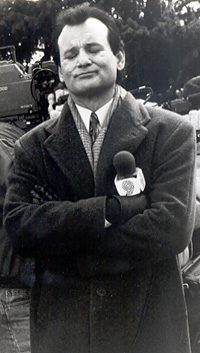
Groundhog Day (1993) is a comic parable about Phil, a TV weatherman who in one long day's journey of the soul moves from cynicism to compassion. His narrow escape into faith is signified by waking up, the beginning of all true spirituality.
Bill Murray, a veteran of many comedies, gives the best performance of his career in this deft and enlightening drama written by Danny Rubin and directed by Harold Ramis. Some critics have suggested that this television weatherman goes through all of Elizabeth Kubler-Ross's stages of grief while others have interpreted Phil's journey as matching Lawrence Kohlberg's stages of moral development. No matter how you interpret it, this film offers a smorgasbord of thematic riches about identity, love, compassion, change, giving, and community.
Groundhog Day runs 103 minutes and is rated PG. For our review of the film and a plot synopsis, click here.
1. THE TASKS YOU ARE HERE TO WORK ON
Ralph Waldo Emerson has written, "The authorities of the universe put you here with some tasks strictly appointed you in your constitution, and so long as you work at that, you are well and successful."
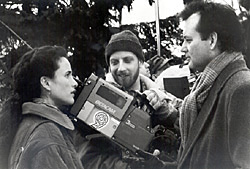
- Is Rita, the television producer, far off the mark when she says that egocentricity is Phil's defining characteristic? What other behaviors and attitudes make this weatherman such a disagreeable person?
- If your spiritual task was to work on diminishing your egocentricity, where would you begin? What tasks do you believe you're here to accomplish? What character flaws would you like to work on?
2. TRAPPED IN DAYS THAT SEEM JUST LIKE YESTERDAY
At one point in the movie Phil asks two drinking companions, "What would you do if you were stuck in one place and every day was the same and nothing mattered?"
- What are some of the clever and innovative ways Phil tries to cope with his plight? Would any of these work for you?
- Do you ever feel like a sleepwalker trapped in repetitive days? What spiritual practices have helped you combat this malaise of the soul?
3. RELATIONSHIPS AS TEACHERS
In What Are You Doing with the Rest of Your Life? Choices in Midlife, Pamela Payne Hardin writes: "Relationships provide the fastest and clearest way to see shadow parts of ourselves that we have denied or buried. We have to embrace our basic flaws and negative feelings for true intimacy to grow."
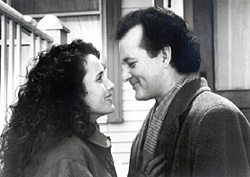
- At what point does Phil find himself in love with Rita? How does he first try to win her heart? When does Phil succeed in getting her attention? What changes does he have to make in his character?
- What have you learned about the shadow side of your personality in love relationships? What flaws in yourself have you come to accept?
4. YOU WANT TO CHANGE YOUR WORLD, CHANGE YOURSELF
After learning about Phil's predicament, Rita says in the film, "Sometimes I wish I had a thousand lifetimes. Maybe it's not a curse, it just depends how you look at it."
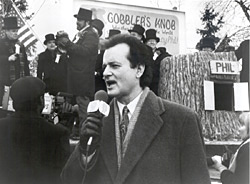
- At what point in the drama does Phil pull himself off the path of cynicism and put himself on the path of compassion? Why do you think his point of view toward life in Punxsutawney changes?
- Give an example from your experience where changing your view of things transformed your life in an important and lasting way.
5. LITTLE ACTS OF KINDNESS
"Do not forget," Teilhard de Chardin has advised, "that the value and interest in life is not so much to do conspicuous things...as to do ordinary things with the perception of their enormous value."
- Which of Phil's little acts of kindness do you appreciate the most? What do they say about seeing enormous value in ordinary things?
- What little acts of kindness by other people have enriched your life recently? Do they inspire you to act likewise?
6. FIND A WAY TO GIVE TO OTHERS
"We all have, without exception, a very deep longing to give...that's true for every human being. And even the ones who don't find it, it's because it has been squashed or somehow suppressed in some brutal way in their life. But it's there to be discovered. We all long for that. And there's a tremendous sorrow for a human being who doesn't find a way to give," Buddhist writer Jack Kornfield has observed.
- Trace the series of scenes where Phil passes the homeless wino and compare them with his final responses to the man.
- What satisfying ways have you found to give of yourself to others?
7. ACCEPT PEOPLE JUST AS THEY ARE
In From Brokenness to Community, Jean Vanier writes about the way community can transform us and our view of others: "Commmunion means accepting people just as they are, with all their limits and inner pain, but also with their gifts and beauty and capacity to grow."
- What does Phil's last Groundhog Day report reveal about his spiritual transformation? How has his views of people and this small community changed?
- In what settings have you experienced "communion" as defined by Jean Vanier and as experienced by Phil in the last part of Groundhog Day?
This guide is one in a series of more than 200 Values & Visions Guides written by Frederic and Mary Ann Brussat. Text copyright 2001 by Frederic and Mary Ann Brussat. Photos courtesy of Miramax. This guide is posted as a service to visitors to www.SpiritualityandPractice.com. It may not be photocopied, reprinted, or distributed electronically without permission from Frederic and Mary Ann Brussat. For permission and for a list of guides in the Values & Visions series and ordering information, email your name and mailing address to: brussat@spiritualrx.com.