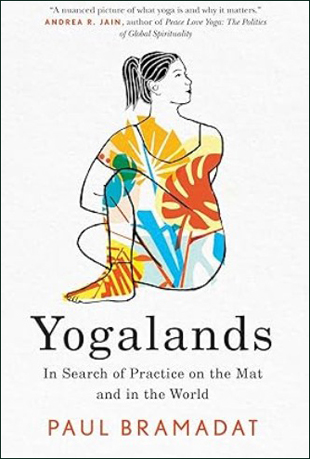
“In my first few years at the shala, it was nearly impossible for me to chant without thinking about the core claims in the sentences being uttered. When I tried to join the others in the room, the words stuck in my throat, so I hummed along or just mentally checked out. But in the past several years, things have changed. Now, I quite appreciate the chant and no longer think about the line-by-line English translations that my mind used to superimpose over top of what I was saying in Sanskrit.
“In some sense, doing so is a compromise, perhaps even a capitulation to a set of ideas and practices that originate in or bear a strong family resemblance to religion. Perhaps it just means that I have become — despite my best efforts — a normal member of a normal religionish group, with some degree of the conformity that this membership entails. Nonetheless, it seems to me that most of my fellow teachers and students are content to bracket the esoteric philosophical elements of the invocations heard in studios across yogaland. Instead, their focus is on the feelings that the invocation allows — both the sense of solidarity with others in the room and the ineffable feeling of wholeness that the experience occasions in their bodies.”