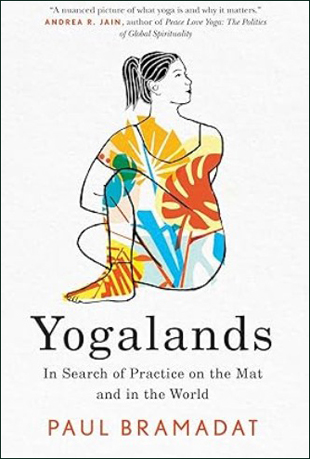
This book caught our attention due to some of the questions it asks. For example, is yoga religious? Does it matter whether or not it is? Also, modern yoga often poses as a kind of escape from the everyday world — is that accurate?
Paul Bramadat engages with popular culture, including popular understandings of yoga in North America today. He’s director of the Centre for Studies in Religion and Society at the University of Victoria, and he practices and teaches Ashtanga yoga. He occupies a unique space midway between practicing yoga without concern for its philosophical or spiritual rationale and also at times delving deeply into complex yoga texts and mystically sophisticated teachings. He does both in this book.
The dedication page — before the table of contents — perhaps says it best: “This book is for yoga teachers who wonder what draws students in their studios, for students who are curious about the links between their bodies and the larger world, and for scholars who wonder how to remain human when they study what enchants them.” Bramadat is clearly such a scholar, “enchanted” by the philosophical study of yoga, and yet he returns often also to how the body, in yoga, discovers what is true, more than any text can tell it.
Most interesting was chapter 2, “Religionish,” in which the author — a religious studies professor — addresses a comment heard frequently in yoga studios: “What I like is that yoga has nothing to do with religion.” In other words, yoga is SBNR. He considers this while looking around the studio and seeing bronze statues of Shiva and Ganesh and other divinities of the Hindu pantheon, copies of the Bhagavad Gita, references to gurus. He also remembers the Sanskrit invocations that usually begin a session, and the conformity that is expected of people who come to participate. He begins his response by saying that what happens in the studio “is also not not religious, right?” The discussion that follows is fascinating, revealing subtle ways in which yoga, for so many, is spiritual, yes, but also religious without being religion.