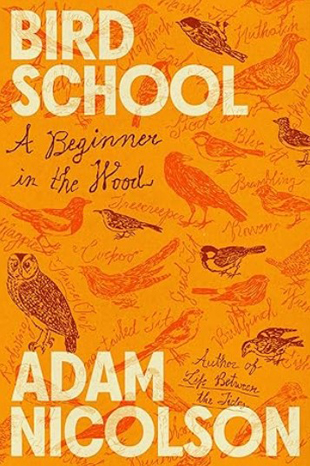
I would purchase a copy of this book for every one of you if I could. It is one of my favorite books of the year, plus it came at just the right time: as the snow continues to fall and I lovingly feed my birds just outside our living room windows.
Author Adam Nicolson built an observatory shed on the farm where he lives in Sussex, England, enabling him to get really close to the birds he was seeing out the window and in the fields. He describes this process, the locale and nature’s rhythms there, and all of his motivations. He’s a beautiful and clear writer.
A color insert of 37 photographs is different from what one usually finds in bird identification books. Here we have birds in profile, like friends (Woodcock, Greenfinch, Redpoll, etc.); lush bird habitats from the author’s ramblings; shots of places on Nicolson’s property where he does his close bird-watching; even reproductions of Giotto’s famous proto-Renaissance paintings of Saint Francis of Assisi preaching to birds.
There are also dozens of black-and-white photographs of birds and many other things, such as evidence of “woodpecker vandalism”; an ancient stone relief from the Gallo-Roman period in France showing a man with birds on his shoulders and a dog by his side; a map showing tracking of eighteen months in the life of an Olympic Raven on the Olympic peninsula in Washington State; bars of sheet music from Robert Schumann’s “Vogel als Prophet” (“Bird as Prophet”), for piano, that Nicolson tells us “is full of birdlike leaps and alightings. Silences intervene between the unlinked phrases,” demonstrating more than anything else, Nicolson says, “The beauty of birds is in their resistance to understanding.”
He brings a contemplative spirit, and a memoirist’s gentle touch, to what is also a biological, ornithological, and cultural pursuit full of enthusiasm.
Pages weave together ecological history and theory, reflections on our relationship to nature and birds, quotations to inspire from earlier bird lovers such as poets John Clare and Emily Dickinson, thoughts on birdsong, and on human-bird comparisons and parallels, and pursuits of specific species and birds throughout Nicolson’s native Sussex.
It’s a substantial book of more than 400 pages and hundreds of endnotes, even an index. The reader has plenty of resources with which to join Nicolson in his studies at “Bird School.”
But after all the beauty, and inspiring pondering of meaning to be had for life from feathered creatures, perhaps my favorite part was toward the end in the “Roll-call of the Birds of Hollow Flemings, Perch Hill” — the wooded area on Nicolson’s farm where he spends his time with birds. 45 birds from Blue Tit to Skylark are described, identified, and pictured in black-and-white sketch. Nicolson also describes what each species seems to prefer eating each season of the year — for those of us wanting to live more deliberately with the birds out our own windows; and he provides a QR code for each that connects to song samples of that species from throughout the world.