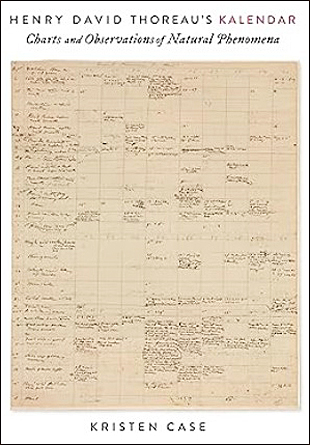
The centerpiece of this oversized, illustrated book are six “multipage charts of general phenomena” drawn by Henry David Thoreau in his last decade of life “at the height of his intellectual powers and the peak of his political engagement,” as author Kristen Case explains. This was long after he wrote his famous book from Walden Pond. These charts — which may have been an intended blueprint for a late written work that never materialized — were Thoreau’s attempt to perceive and record how and when the seasons of each year unfold, and how phenomena, including the human observing this, relate to one another as the seasons move.
As Case makes clear, and so do the beautifully reproduced charts on these pages, Thoreau viewed his life as folded within a greater whole of all created things — and he was trying to understand it as best he could. As he said: “our thoughts & sentiments answer to the revolution of the seasons, as 2 cog wheels fit into each other.”
These are the sage of Walden Pond’s notes to support his attempt to have “a more integrated life in nature and time,” as Case explains.
We’ve long known that Thoreau was a forerunner for understanding humans’ place in a broader network of relations that we now call an ecosystem. He was always writing and speaking in favor of connecting — or re-connecting — with the world, paying attention, being present, and practicing wonder, realizing that we’re one small part in a much larger world. He was doing this to combat what became common in his lifetime and hasn’t left us; he called it the “restless, nervous, bustling, trivial Nineteenth Century.” We need only change the word “nineteenth.”
So these close reflections on changing phenomena in Thoreau’s natural world may bring some of us to reflect again with one of our classic American writers on our own need, in our own time, to stop. Pause. See. Observe. Reflect.