
 Are We Responsible for the Consequences of Our Actions?
 Posted by
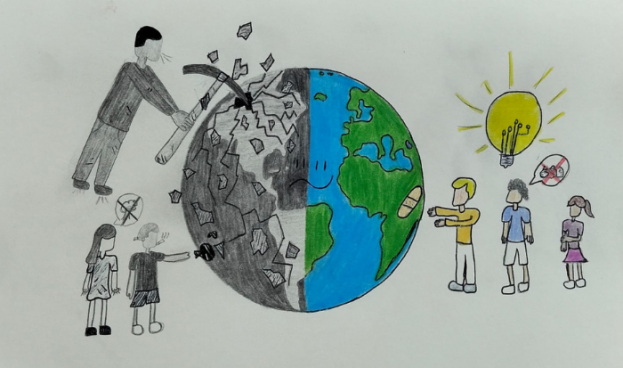
Artwork by Liz Fabiola Galeano Roa, age 16, Paraguay
Written by Finnegan Fox Kelly, age 16, Brooklyn, New York
I have been raised in the United States.
Most people here grew up in an Abrahamic-religious context, as most if not all have at least heard of the story of the Bible, which espouses the idea of free will, the idea that our choices are up to us and generally not in the control of external forces. We are also quite the individualist nation, as I’m sure you’ve heard a thousand times by now, which has led many to believe themselves the singular driver of all of their decisions. Due to these factors, most Americans think they are responsible for pretty much all of what they do, and the repercussions that come with their actions. Perhaps it speaks to some human want, or even need, to feel in control, to feel that no matter what happens, the roll of the dice was up to us, and that no one was fudging with the numbers.
I too grew up believing this. I attended a Christian school from pre-K to eighth grade, and it was hammered into my mind that because God gave us the ability to do what we want, whenever we want, I, in turn, carried all of the responsibility for the consequences of my actions; a sort of deal. Believing in such an idea is not inherently bad or harmful. Thinking that I must account for every action of mine led me to try to better myself, and avoid deeds that would harm others, and probably made me much more sympathetic than I would have been without these preconceived notions informing my every action. Believing in free will leads people to think that we are the only ones in control of our destinies, that we alone reap the consequences of our actions. However, I find this chassis to not cover every corner of human interaction, and it has a few notable blind spots, including, but not limited to, peer pressure.
Peer pressure is very common in everyday life and leads us to push ourselves to do many things that we otherwise would not have done. Try this on for size: your friends are all doing wheelies in a parking lot with their sick new rides, having a great time, and one of your closest friends, Chet, asks you to join them right before they do their most daring trick yet, and ride off a ramp, over a car, Evel Knievel style. You know that they may seriously hurt themselves and others if they do, but everyone joins in and tells you to do it with them, or else, you are a wuss! What do you do? Not to speak for everyone, but it would be a hard choice for me to make. If you don’t join in and everyone ends up alright, you are missing out on a valuable bonding moment between you and your friends. If you do, you may hurt bystanders, damage a stranger’s car or worse. This is a situation in which it is unclear whether we share the whole responsibility for the consequences of our actions or not. If it were solely up to you, I would bet that you would not ride your bike off a ramp, but, given the extra variables of your friends and their words of encouragement, you very well may. Situations such as these cast doubt on the notion that we are the sole inheritors of the consequences of our actions, and shoulder all of the responsibility, and instead suggest that the picture is much larger, and that responsibility is spread between all parties involved.
You may rebuke the previous example I gave, and say: OK, we can establish that life is too complex for there to be one sole recipient of responsibility, but what if you did not know that this was a stranger’s car they were jumping over? Or that it would be possible to hurt yourself or others? In other words, what if we don’t know the possible consequences of our actions — are we still responsible? One way to respond to this is by looking at how we treat involuntary manslaughter.
Involuntary manslaughter, as in causing the accidental death of another human, is a case in which it is unclear if one truly has a stake in the ramifications of what they have done. If you unintentionally put your foot on the gas instead of the brake, and hit a person, or if your car malfunctioned, lurched forward, and hit them, would you be responsible? In the latter example, is the car manufacturer responsible for the faulty product? Are you both? Are neither of you? It is clear that both nature and human mistake, both factors outside of our control, led to this event taking place, but then what do we do with the accidental perpetrator? Can we just let them go, and seek no justice for the party killed? Most countries still punish those who commit accidental crimes, so is it fair to say they are responsible despite the fact it was not purposeful? It is impossible to say with certainty whether one answer is correct.
I would argue that it is impossible to say if one should be made responsible for an accidental act, but, I would lean toward no party being punished, as to minimize damage. Your response may be the same, or entirely different. As humans, we were not born with a sense of morality or justice; instead the idea of what these concepts should look like were planted and molded within by those who raised and had influence over us, alongside real life experiences. Thus, our senses of morality, and who shares responsibility, vary.
In my own opinion, our share of the responsibility for any action varies depending on the context. To tie back to my previous example on accidental manslaughter, you would share little blame, as unintentionally putting your foot on the gas is something that happens, human error. To say that one is responsible for an action without the intent to commit it is antithetical to the human experience, and if anyone has lived, they will know this to be true. When one is peer pressured, however, I believe it to be less clear, as there are so many variables at play, such as your relationships with those involved, and if you are simply using peer pressure as an excuse to do what you already intended on doing. Overall, it is unclear how much of our actions are our responsibility, but I believe that we can divide our blame based on how much power we have to leave a situation, our intention to commit an act, and our knowledge of what will come as a result of it.
Finnegan Fox Kelly was 16 years old when he wrote this article. He is from Brooklyn, New York. In his free time, he has been delving deep into one of his interests: Byzantine history, which has influenced his other hobbies of whittling and iconography.