
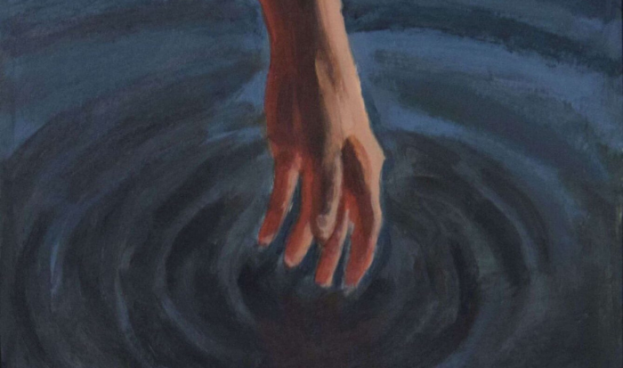
 The Ripples of a Cabbage Dumpling
 Posted by
Art by Fatima Faisal
Written by Isabel Zhang, Australia
Most of my early years were spent in the care of my grandparents.
It was in their small backyard garden that I first learned the names of wild weeds and vegetables in their language, Mandarin Chinese — the same language they spoke to me in, day in and day out. They often kneaded their own dough and harvested chives from their back garden, teaching me how to mix them with pork mince, wrap them in delicate handmade skins, and we’d all have tummies full of chive pork dumplings by lunchtime.
And as the days went by, it was time for me to start school. By then, I still did not know much English — only the miscellaneous words my grandparents had taught me — that “mama” was at “work,” that to bargain for the price of a bag of “apples” at the local fresh produce market, you should tell them that “two nine-nine” was “too high,” and “not good,” and that to make friends at school, I should offer them a dumpling and say “for you.” And on that first day of school, when I opened my thermos for lunch, I was not met with the distinct, yet familiar scent of Chinese chives, freshly cut from the garden, but of cabbage bought the other day from that very fresh produce market, which did not smell like much at all. It was gentler — a more forgiving scent for unfamiliar, Australian noses.
In an unfamiliar place with unfamiliar people, wearing my new school dress, eating dumplings that didn’t taste quite right on my tongue, another little girl came up and sat herself beside me. She pointed at my lunchbox, tilting her head as her curly blonde locks shifted to one side, and asked, “what’s that?” At that moment I froze — I looked down at my lunchbox, unsure of what to say, unsure of whether the words I had were enough. I remembered my grandmother’s advice: offer them a dumpling and say “for you.”So I picked one up with my little fingers, and held it out to her.
“For you,” I said softly.
She blinked, then smiled, and reached for it. “Thanks,” she replied, chewing thoughtfully before saying, “It’s good.”
At that moment, I was able to connect with someone in English for the first time. Though we struggled to communicate for months, our exchanges of dumplings for half a Vegemite sandwich or little bits of pasta covered in red sauce continued as my language fluency and I began to feel that maybe, just maybe, I belonged.
I was faced with a similar predicament around a month into the school year in year nine. She was one of a dozen new students in our grade that year, walking in cautiously with her structured, shiny school-bag and school-dress past her knees. Though, like many of us, she had brown eyes and black hair tied up in a high ponytail secured with a white bow, the moment she spoke, you could tell that she was a little different from the rest of us. Her accented English stood out in a room full of fast-talking twelve-year-olds, and her meek, uncertain presence contrasted sharply with the noisy chatter of the classroom.
For weeks, I sent glances her way — I recognized the lilt of her accent as one that belonged to my mother and a monosyllabic surname that rhymed with my own, but how would I even speak to her? Would I try using my rusty mother language, fumbling through vaguely familiar vowels and consonants that had felt foreign on my tongue since I started school — where English was the language we all shared? Or would I speak to her in English, clear and confident, but isolating her in the way that the rest of her unfamiliar environment does? My hesitation bluntly came to an end though when I dug through my well-worn school bag, turning it inside out while trying to find my make-shift wallet — a zip-lock baggie containing a five dollar note and various coins to pay for my canteen lunch.
My hands rifled through worksheets, pen caps, and an unfinished tube of lip balm as I frantically searched for the baggie. I could already see the line build up behind me, and as I felt a tap on my shoulder, I mentally prepared myself for the apology I’d have to make. But when I turned around, there she was, the new girl. She looked unsure as she held out a purple five dollar note of her own.
“Here… you can borrow mine.” I blinked, momentarily caught off guard. No one ever just offered you money in the middle of the canteen line, especially not someone you hadn’t spoken to. But as I heard her wavering voice and her shaking eyes, I saw an echo of my younger self in her, and I remembered back to my own experience when just living my everyday life, trying to communicate with the people around me, was difficult, and took courage.
I hesitated, unsure if I should accept. But to me, it felt like a token of friendship – her pork cabbage dumplings, offered when she needed a friend.
So I nodded, quietly taking the note from her hand. “Thank you,” I said, my voice soft, as I paid for my lunch with a murmured apology to the canteen lady. As I turned around with my tray of a hot meat pie, she was still there, waiting.
We ended up sitting together that lunch. We didn’t talk much, afraid of using the wrong words, or the wrong tones. But as I tried to crack a joke in her language, I saw her smile just a little — a small, tentative smile — and I realized that whatever line I was imagining between us, it wasn’t real. She wasn’t trying to make it awkward. She was just offering what she could, as if digging her hand — bigger, braver, but no less shaky than mine was — into her thermos for a cabbage dumpling.
And somewhere in all of this, I realized that the kindness I had once been shown, all those years ago in a noisy schoolyard over a single dumpling, hadn’t just faded away. It had stayed with me, quietly waiting for its moment to ripple outward. Her simple offer—a five dollar note held out with trembling hands — reminded me of that first friendship, of how a small act of welcome had changed everything for me. And in choosing to sit with her, to speak, to stay, I was returning that kindness, letting it pass through me and into the world again. Because kindness doesn’t end where it begins. It echoes. It builds. It moves forward, one small ripple at a time.
At the time of publication, Isabel Zhang was 18 years old and living in Melbourne, Australia. She loves to write about topics she holds close to her heart, such as her involvement in her sport and her local community, as well as a diverse range of social issues that pique her interest.