On election night, 2024, voters in the United States stared at the map and saw whole counties, then states, turn red or blue. Red meant one thing, blue another.
As more states ended up red than blue, I thought, “I don’t know this country.”
In the daze of November 6, 2024, what I meant was, “I didn’t expect this.
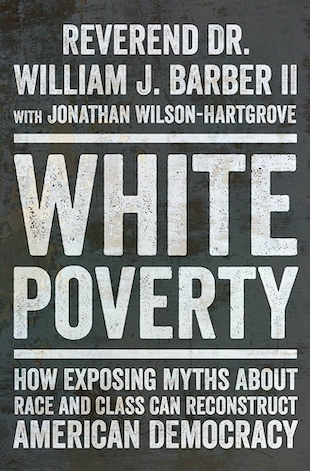
But as the shock of President-Elect Donald Trump’s victory wore off, I shifted tone. I remembered what I’d learned from The Poor People’s Campaign (PPC) and Reverend William J. Barber II, whose most recent book is entitled White Poverty: How Exposing Myths about Race and Class Can Reconstruct American Democracy.
This is what I remembered: There are 140 million poor and low-income voters in the United States, and many of these folks do not vote because no one represents their interests. With little exception, politicians simply do not talk about poverty — because, as then-candidate Pete Buttigieg confessed to Barber in 2019, “Rev., . . . the reason we don’t talk about poverty is that the consultants tell us not to.”
Electoral maps only show us who voted; they render invisible those who — to paraphrase Martin Luther King, Jr. — had nothing for which to vote. My despairing election-night sentiment, “I don’t know this country,” then, was based on the very prevalent and very faulty myth that maps of red and blue counties represent the country. They don’t; they represent the voters only.
The hope in all of this is that the election results do not actually tell the story of our country. White Poverty does a much better job.
For instance, Barber’s research tells this story: “Places that are controlled by reactionary extremists who serve corporate interests are not ‘red’ counties so much as they are unorganized counties where the largest block of voters isn't Republican or Democrat, but rather poor people who often do not vote.”
The largest block of voters is poor people who often do not vote . . . A more equitable, just democracy doesn’t come from the voting that happens every two to four years. It comes from organizing.
And it will come, specifically, from fusion organizing. The word fusion, for Barber and the PPC, recognizes that 140,000 people identify as disenfranchised more than they identifyas Democrat or Republican. It also recognizes that most of those disenfranchised poor are white.
This bears repeating for the same reason it was necessary for Barber to write the book: “most of America’s poor are white,” 66 million, “almost three times the number of Black Americans.”
Racism and the American Dream have worked together to create the myth that poverty in America is a Black problem. When we see that, by raw numbers, we would have to describe poverty in America as a “white problem,” it becomes impossible to see poverty as a glitch in the system. It is a feature. How might our discourse about democracy — and the rhetoric of campaigns — change if we allowed these numbers to speak?
The strength of this book is that Barber makes those numbers sing — in his own voice and also in the flesh and bone of poverty’s witnesses. Barber writes out of his prophetic call as a minister, demanding that people and policy respond to God’s mandate on human dignity.
In service of that dignity, Barber does in the pages of the book what he does on the stages where he speaks: he hands over the microphone to poor people, whose expertise with the lived reality of poverty cuts through every sinew of political foolishness.
You will meet, and love, Lakin, a young queer woman from Corbin, Kentucky. Lakin showed up to an organizing meeting and talked about how she adored her hard-working parents and how, when she came out, they rejected her, leaving her to live in her car “while she worked three minimum-wage jobs to pay her way through college.”
You will also meet, and love, Pam, a mountain-woman from West Virginia who took on Senator Joe Manchin on voting rights and raising the minimum wage. “They always say voter suppression is about hurting Black people,” Pam told Barber, “but they're pushing these laws up here in West Virginia, and we ain't hardly got no Black people.”
(Another West Virginian woman got right to the point: “Senator Manchin, I know your mama . . . I know where you come from, and I can't believe you're treating poor people like this.”)
White Poverty has the data, myth-busting, and inspiration we need to overcome our grief and revitalize the work of justice. I started reading it before the election, and it made me hopeful. I picked it up again and finished after the election, and my hope was restored.
Or perhaps I should say, my sight was restored. Presidential elections come every four years, and they shorten our field of vision to immediate results. In contrast, righteous movements like the Poor People’s Campaign enlist our vision in the long-term planning that brings real change.
It can be hard to train our focus on a movement, not a moment. White Poverty is a worthy companion in that struggle.