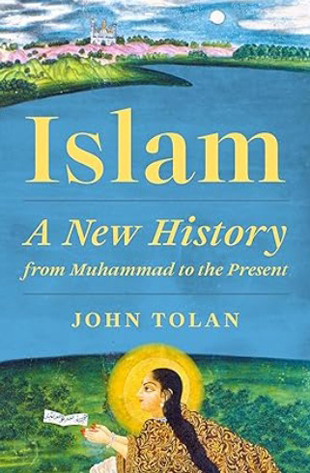
Previous histories of Islam have tended to over-simplify the religion, explaining the Prophet Muhammad, and then Sunni and Shia branches, without much else. This has led to misunderstandings and prejudices against a religion that now numbers around two billion people. Islam is both more diverse and more complicated than we previously imagined.
This is the focus of John Tolan’s new book — a helpful and insightful study for anyone who enjoys reading popular history. Tolan shows the connections between Islam’s history and politics, region by region, and how this relates to the religion as it is practiced today.
Part Three, “Modernities” — following parts on “Foundations” and “Expansion” — is full of fresh inquiry. Part Three focuses on the legacy of colonization — British India, the dismemberment of the Ottoman Empire, the French conquest of Algeria, plus other topics and locales, followed by a chapter on modern decolonization and how it was often followed by nationalism. All of this has had an impact on Islam throughout the world.
This leads to a final chapter, “Between Reform and Radicalism: Being Muslim in the Twenty-First Century,” where Tolan writes: “Between the mid-nineteenth century and the beginning of the twenty-first, Muslims all over the world have been caught up in debates about the relationship between Islam and modernity. Should Muslims modernize Islam or, on the contrary, Islamize modernity?”
Tolan’s take is even-handed and he writes as an outsider, yet one who has passion and interest in religion generally and all three major Abrahamic religions specifically. His previous books include ones on Judaism and on Saint Francis of Assisi. When Tolan discusses the veil or headscarf in twenty-first century Islam, for instance, he’s able to do so by drawing important parallels in the history of Judaism and Christianity.
Never before has so much modern history of Islam and its development been offered in a concise and readable way, with hope for the future.