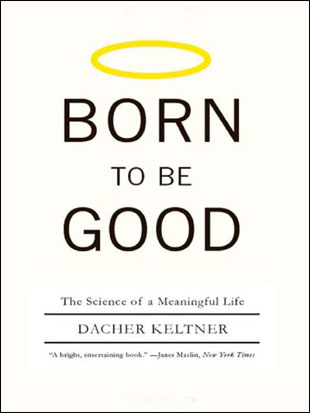
Dacher Keltner is professor of psychology at the University of California, Berkeley, director of the Greater Good Science Center, and coeditor of Greater Good magazine. His research focuses on pro-social emotions, power, and reasoning. He begins this fascinating book with a look at the importance of Jen, a central idea in the teachings of Confucius. The term refers to "a mixture of kindness, humanity, and respect that transpires between people." These qualities bring out the best in ourselves and in others. They play a major role in the evolution of human goodness.
Keltner next looks at Charles Darwin's writings about positive emotions. He posited that sympathy is our strongest passion and can make all the difference in our relations with others. The author also salutes the scientific work of Paul Ekman, who pioneered the examination of emotional expression through the many movements of the face. This is followed by three findings from new studies in positive emotions: (1) Emotions are signs of our commitment to others; (2) Emotions are encoded into our bodies and our brains; (3) Emotions are our moral gut, the source of our most important moral intuitions. Although we are accustomed to thinking that the survival of the fittest is the law of evolution, Keltner posits that a better description of the human adventure would be the survival of the kindest, since we are a caretaking species.
In the last eight chapters of Born to Be Good, the author provides a consistently interesting assessment of eight emotions along with insights about them from art, literature, and philosophy. They are:
• Embarrassment (an ethic of modesty)
• Smile (as social chocolate)
• Laughter (the first step to nirvana)
• Tease (the perspective of others)
• Touch (an inexhaustible resource of rewards)
• Love (back to the birds and the bees)
• Compassion (a progenitor of courageous acts)
• Awe (unites us all)