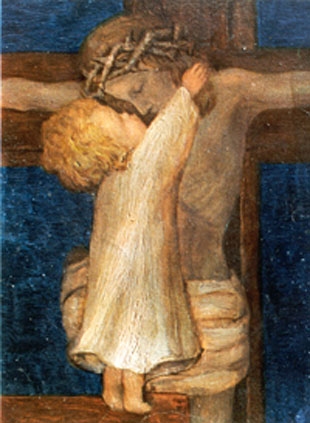
For centuries, people have tried to understand the power and the significance of Jesus' suffering on the cross on Good Friday. Here are two responses today, from the Practicing Spirituality with Jesus e-course that was first offered during Lent.
In the meditation for Palm Sunday, we encouraged people to identify with Jesus during the events of Holy Week and to allow themselves to be deeply moved by the Passion story, especially on Good Friday. We wrote:
"There's an old saying: You can't have Easter without Good Friday. Many people today express the desire to have an open heart, a loving heart, a compassionate heart. Well, how do you open your heart? Usually, it's broken open. Jesus on the cross breaks your heart. He breaks it open. You can't look at the crucifixion without having an experience of compassion. Only a heart broken open — one that can have compassion for those who suffer — can truly appreciate the new life represented by Easter."
The "Practicing Spirituality with Jesus" quotation for Good Friday is from the late Sri Eknath Easwaran, an India-born spiritual teacher who founded the Blue Mountain Center of Meditation in California. For him, the cross represents a gift from Infinite Mercy and our response must be to practice patience and mercy:
"One day our hosts [at a retreat in the Southwest] took us to see a stunning chapel built up against the red sandstone of the desert hills. As we entered, I felt as if I had received a blow. Right in front of us rose a lifelike sculpture of Christ in agony on the cross. The eyes were hollow with pain and the mouth seemed to be crying out, 'Haven't I suffered long enough? Can't you all join hands now and lift me down from this cross?'
"Whenever we utter an angry word or raise a hand against our neighbor, we are driving in another nail to keep Jesus up on that cross. The principle underlying the Passion is that out of his infinite mercy, the Lord has taken our suffering upon himself. As long as any living creature is in pain, so is Jesus, for he lives at the heart of all. Wherever violence breaks out, no matter how cleverly we try to justify it, we are crucifying the spirit of Christ.
" 'Patience' and 'passion' both come from a Latin word meaning to suffer or endure. When we speak of the Passion of Christ, we are recalling the suffering he endured on the cross. But it is good to realize that whenever we practice patience — cheerfully bearing with somebody who is irascible, or enduring discomfort rather than imposing it on others — in a small way we are embracing the principle of the Passion. Each of us can bear a little of such self-denial, and with practice, our shoulders can grow broad enough to carry some of the burden of those we love. In this way, the mystics tell us, by practicing mercy throughout our lives, we take upon ourselves some of Jesus' burden of pain."
— Sri Eknath Easwaran in Original Goodness
 Spiritual Practices
To Practice This Thought:
Be patient. Bear the burdens of others. Practice mercy.