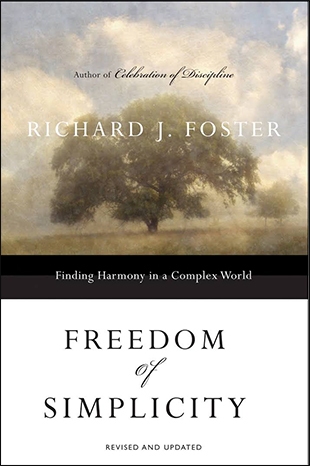
Richard J. Foster is the author of several bestselling books including Streams of Living Water and Prayer: Finding the Heart's True Home. He is profiled in the Living Spiritual Teachers Project, is the founder of the intrachurch movement RENOVARE, and the general editor of The Renovare Spiritual Formation Bible. This paperback is an updated edition of Foster's 1981 book on the spiritual discipline of simplicity and the role it has played in the Bible and in the lives of saints. He sees it as a gift of God as well as a practice that can be incorporated into daily life: "It brings sanity to our compulsive extravagance, and peace to our frantic spirit. It liberates us from what William Penn called 'cumber.' "
Foster finds that simplicity is rooted in the Old Testament through the themes of radical dependence, radical obedience, the generosity of God, the joy of giving, the call to justice, and the challenge to live in compassion and wholeness. The practice of simplicity in the New Covenant is spelled out in faith in Christ the center, identification with the poor, awareness of the dangers of wealth, the incendiary fellowship, ability to surrender one's rights for the good of others, and unconditional generosity.
Foster presents six models of Christian simplicity: exuberant sharing and caring (the period following the Apostolic age); the power of renunciation (the Desert Fathers and Mothers); the joy of simplicity (Francis of Assisi); theology in the cause of simplicity (the Protestant Reformation); hearing and obeying (seventeenth-century Quakers); and simplicity in action (John Wesley and the early Methodists). In the chapters on the practice of simplicity, Foster emphasizes the inward virtues of holy obedience, joy, and humility. He covers many topics in his treatment of outward simplicity including voluntary poverty, unplugging from consumer society, the gift of giving, service especially to the poor, and sacrifice.
Foster hopes that the church will do more teaching about the inner and outward aspects of simplicity with an emphasis on the biblical and theological foundations for justice and the relationship between simplicity and peace. In closing he suggests some directions for Christians to impact the corporate world and the marketplace with the spirit of simplicity. Here is a sampler of quotations from the book:
• "O, how amiable this simplicity is! Who will give it to me? I leave all for this. It is the pearl of the Gospel."
— François Fenelon
• "I recommend to you holy simplicity."
— Francis de Sales
• "The older I grow the more clearly I perceive the dignity and winning beauty of simplicity in thought, conduct, and speech: a desire to simplify all that is complicated and to treat everything with the greatest naturalness and clarity."
— Pope John XXIII
• "To be simple is to fix one's eye solely on the simple truth of God at a time when all concepts are being confused, distorted, and turned upside down."
— Dietrich Bonhoeffer