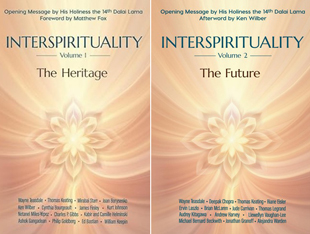
“What Teasdale termed Interspirituality was not new. Earlier, Raimon Panikkar had called it the intraspiritual experience, Matthew Fox deep ecumenism, and Thomas Merton the mystical communion. Eastern writers had added a number of expressions for it as well. The emerging paradigm actually reflected the vision of over fifty major historical religious figures who emphasized a ‘commonality of heart’ across all the world’s traditions. Thus, it is no surprise that today we see Interspirituality nearly everywhere, under a variety of names and with the brandings of diverse groups and leaders worldwide; not just as Interspirituality, but as global, ecumenical, universal, transtraditional, or world-centric spirituality, along with the spiritual but not religious, the nones, and the multiple belonging….
“[For example], evolutionary biology has come to recognize that Interspirituality is exactly the adaptive trait that would naturally arise within religion as the world moves toward inevitable globalization and multiculturalism, not only because that adaptive trait would be required of a globalizing civilization, but also because current evolutionary theory shows that natural selection at the level of groups and systems of groups chooses the best cooperators, not the best competitors. This recognition has been widely discussed by The Evolution Institute and in publications from Yale University and The Templeton Foundation.”