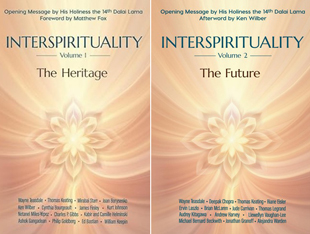
These two volumes are clearly a labor of love for the editors, who explain in the opening paragraph of their Introduction how they undertook this big project to mark the twenty-fifth anniversary of Wayne Teasdale’s “now classic book,” The Mystic Heart – the book in which “Interspirituality” was named. They quote Teasdale’s definition of the term: “The common heritage of humankind’s spiritual wisdom; the sharing of mystical resources across traditions.” Then they quote Teasdale’s invoking of “the Inspiritual Age”:
“The name for the age we are now entering, where people are no longer isolated within their home tradition but are exploring other traditions, finding what is useful to their own growth.”
Everything that follows — mostly through carefully chosen excerpts from other books, talks that have been given, passages that had previously appeared only on websites, and the occasional original piece written for purposes of this project — are woven together to create what the editors refer to in one of about a hundred source notes as “a thematic and historical chronicle.” It is that. It is also a little jumbled in organization and repetitive in content. Nevertheless, these volumes tell an important story.
Most of our readers will know one or more of the names of teachers who, through their work, are “contributors” to these volumes. These include Thomas Keating, Mirabai Starr, Joan Borysenko, Ken Wilber, Cynthia Bourgeault, Matthew Fox, James Finley, Ervin Laszlo, Andrew Harvey, Brian McLaren, and Kabir and Camille Helminski, among many others. As often happens, one doesn’t have to join a group in order to be placed there in a book such as this — and it isn’t clear to what degree this group of teachers has endorsed this project to which they have most certainly contributed. Among them, however, Matthew Fox and Ken Wilber are certainly self-defined practitioners, since they penned a foreword and afterword, respectively, for this project.
A very dense eighteen pages of “Timelines” attempts to track or chronicle the developments of Interspirituality starting in 1999 (with Teasdale’s book). These cover publications, key figures, organizations, gatherings and conferences, and events through 2025.
A section of “Benchmarks” follows this, and they include, in Volume 1, “early historical interspiritual foundings” such as Satyana Institute, Snowmass Dialogues, Spiritual Paths Institute, Interspiritual Dialogue Network, and One Spirit Interfaith Seminary. And in Volume 2, key moments of interspiritual dialogue are noted, as well as the internet presences of 1God.com and Unity.Earth. Key figures (who were less known to me), then follow, including Mussie Hailu, Kurt Johnson, Ken Kitatani, Yanni Maniates, and Chief Dwaine Perry.
The editors also point to essential precursors to Wayne Teasdale’s naming of Interspirituality — namely, Raimon Panikkar’s “intraspiritual experience,” Matthew Fox’s “deep ecumenism,” and Thomas Merton's writing about “mystical communion.” (See the excerpt accompanying this review.)
Even those who were there may not remember all that these volumes track and record. These volumes are really not works of spirituality; instead, they chronicle what’s been changing in spirituality. These are essential books for anyone wanting to grasp a spiritual movement that underlies much that’s been happening in the western, somewhat post-religious, world in the last quarter century.
Note: The volumes' respective prices and ISBN numbers are:
Vol. 1 – $27.95 / 9781958921784
Vol. 2 – $27.99 / 9781958921807