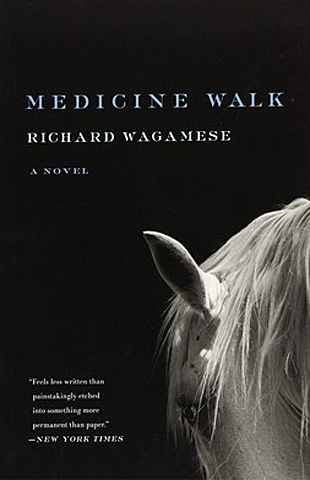
Richard Wagamese (1955 - 2017) was an Ojibway journalist, author, and poet. He grew up in white foster homes, learning nothing of his Indigenous heritage until he was in his twenties. In this novel he offers, “In the Ojibway world you go inward in order to express outward. That journey can be harrowing sometimes but it can also be the source of much joy, freedom, and light.” And Medicine Walk illustrates this beautifully.
Frank Starlight is a sixteen-year-old Ojibway boy, raised by an old man on a farm in northern British Columbia. He never knew his mother, who died giving birth to him. His father, Eldon Starlight, was a drifter who took odd jobs, an alcoholic whose occasional visits usually ended in disappointment. Yet Eldon calls for Frank to come for him when he senses death is near, asking that his son take him to a mountain ridge overlooking a river for burial.
Frank agrees with reluctance, and they travel together through the mountains by horse and on foot. The story shifts in time, moving from the landscape and the journey to Frank’s memories of his childhood and the fracturing experiences of racism, poverty, loss of parents, and broken dreams. Frank hears for the first time of Angie, his mother, in Eldon’s complex love story. The history comes to us in small portions interspersed with the terse give and take between father and son.
Wagamese ensures every aspect of the British Columbia landscape can be seen, heard, smelled, and felt by the reader as Frank and Eldon journey together. Every glance and word between son and father is described in detail. The result is a story that unfolds slowly, requiring the reader to gaze meditatively on each and every scene. Wagamese’s prose holds in tension economy and beauty, enticing the reader to go back to sections again and again to savor them.
Frank journeys from farm to burial site and back. From the outset, one senses in him a deep spirituality of the land, but one that is somehow lacking. The journey, the stories of origin he hears for the first time, and the death and burial of his father stretch his vision to embrace compassion, forgiveness, and redemption. Wagamese frames these themes by drawing on Christian art: Before their pilgrimage begins, he draws a comparison of Christ taken from the cross and in the arms of Mary with Eldon, drunk and dying, sunken into the arms of a prostitute. Nearer to his death, Eldon stands, cruciform, on a cliff, haltingly whispering “Forgive me.”
Traveling this inward road is indeed harrowing. The wisdom won from Frank’s encounter with his father has to be fought for, leaving the pilgrim graced but scarred.
This book was first published in Canada, where the author lived, and is available in Canada as well as in the United States.
_____________
Paul Pynkoski facilitates book studies at the Church of the Redeemer, Toronto, and for their Common Table outreach for people who are vulnerable or homeless. He has contributed essays and reviews for The Merton Annual, The Merton Seasonal, and Orthodoxy in Dialogue.