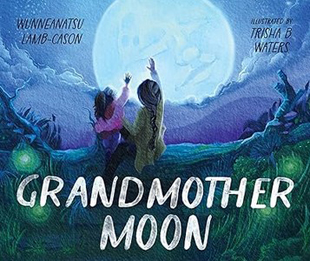
Trusting in benevolent celestial beings who have our welfare in mind can be a strong anchor for any child trying to live in a chaotic, anxious, and often cruel world. Across various traditions, such protective beings often take a feminine form, like Kuan Yin and Tara. Now, from Algonquian understanding, we have a transporting story about Grandmother Moon.
The girl narrating the story, N'Tah ("My Heart"), gets picked up every weekend by her grandmother Nohhum ("My Grandmother") to spend the weekend at her home on the reservation. As they're driving there one evening, N'Tah notices that the moon appears to be following them. Her grandmother confirms exactly what she's seeing: "Of course she's following us, N'Tah. ... She is Grandmother Moon."
When N'Tah exclaims that she sees the moon's face — she's smiling! — Nohhum replies, "That's because she's happy to see you. ... Grandmother Moon is always with us. She is the first of all mothers. She watches over us and her daughter, Mother Earth. We are her grandchildren. She is there to guide you, just as I am here to watch over you and guide you."
Nohhum continues to unfold wisdom about the moon: that you can bring her offerings like food or tobacco, she's always ready to listen if you need to talk, and she sends healing and cleansing powers. These are precious teachings which author Wunneanatsu Lamb-Cason received from her own grandmother when she was a girl, and it's a privilege to be able to receive them through her own skillful storytelling.
Illustrator Trisha B. Waters, whose vow is to help underrepresented children see themselves and their cultures in the books they read, does justice to the joyous, mystical quality of the story through radiant yet realistic paintings. In a poetic section where "shimmery moonlight sparkle(s) along the inky river water," we see the rise of an enormous, golden full moon with an equally enormous reflection in the waters. It turns the bridge and Nohhum's car into silhouettes while fireflies dance among shoreline cattails.
Lamb-Cason shares this story with four-to-eight-year-old readers — and all of us — "with gratitude for my grandmother and all of the ancestors before her who sacrificed, endured, and loved us enough to ensure our cultural survival." Further helping to foster that survival, the author includes a moon calendar with the names of each of the 13 moons and a description of their meanings. She sensitively notes that these teachings from her grandmother are a personal collection passed down for generations; they "may vary from nation to nation and even within the same region."