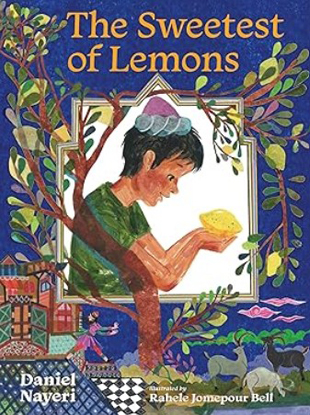
"Once there was, and once there wasn't ..." begins this book's story-within-a-story, as a famous storyteller shares with a traveling boy the tale of the sweetest lemon. This form of nested stories allows readers age four to eight to gradually move from their everyday world, in which an ordinary boy can take a break from a long car journey to listen to a story, to the magical world of Persian make-believe which the storyteller unfolds.
In that world, a poor mother of three sons has only one treasure: a tree that each year grows a single lemon "so perfectly sweet that it cured sadness itself." But each year, the lemon gets stolen before the family can pluck it. After two brothers fail to protect it, the youngest intentionally cuts his hand and drips juice from an ordinary lemon into his cut so that the pain will keep him awake as he guards the tree. Thus he manages to shoot an arrow at the giant who steals the lemon, and the brothers trace the drops of the giant's blood to a deep well into which only the youngest brother is brave enough to descend.
When the boy listening to the story tells the storyteller, "This story sounds made up" — which may be exactly what the reader is thinking — the storyteller brilliantly continues: "Of course it's made up. Now don't interrupt. We're in the underworld for goodness' sake."
And so the story continues, with only the youngest brother being willing to push himself deeper into pain and danger, becoming the story's hero. The story reveals that pain can make someone selfish, or it can do the exact opposite, allowing heroism to emerge.
The illustrator, Rahele Jomepour Bell, grew up in Iran among her grandma's fairy tales and the devastation of war. She holds an MFA in integrated visual arts and is an assistant professor at the Kansas City Art Institute. In her Artist's Note, she explains that she used more realistic gouache for the framing story that anchors readers in a tangible world. But when the book shifts to a realm of pure imagination where anything is possible, she transitions to a collage-based technique. "This distinct visual shift," she writes, "helps the reader move the imagination, effortlessly transporting them from the real into the fantastical, layered world of the imagined tale." She draws proud inspiration from the master of Persian miniature painting.
Her dedication is powerful and poignant: "To my homeland, a place rich in magic and history, with beautiful and kind people. May you be free, Iran; may you be prosperous, Iran." Author Daniel Nayeri, also born in Iran, immigrated to Oklahoma as a refugee and captivated readers with his poignant memoir Everything Sad Is Untrue, which won the Printz Award. His Author's Note leaves us with an Iranian storyteller's ending ... "And now this book has come of an end, but the story yet remains."