Sinners is singular in every way. At times, it harmonizes with other recent socially relevant horror films. At times, it hums with the familiar energy of other blockbuster action thrillers. It certainly fits within the expanding cosmology of Ryan Coogler creations. But even with these echoes, Sinners throbs with freshness, conjuring the vibrant possibilities inherent to a newly discovered sacred text, one that feels deeply rooted in ancient history, thoroughly grounded in the precarious present, and visionarily focused on a liberatory future.
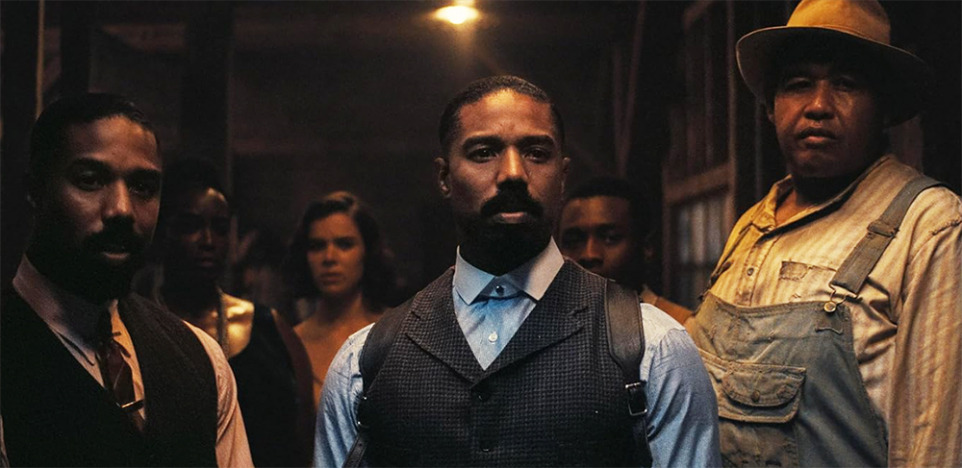
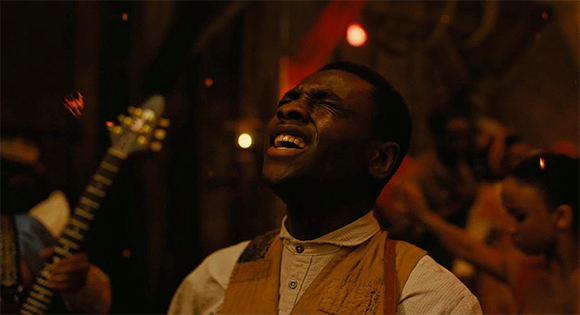
It would be enough for Sinners to be entertaining, because it absolutely is. The central story focuses on twin brothers Smoke and Stack (both played by Michael B. Jordan) returning to their hometown to open a juke joint that will serve as a guarded gathering place for a multicultural melange of marginalized community members. They cross creative paths with musical prodigy Sammie Moore (Miles Caton) and wind up battling a growing band of (figurative and eventually literal) white supremacist vampires. This is never anything less than glee-inducing. It’s an invigorating concoction of pulse-pounding musical sequences, intriguing characterizations down to the smallest role, and a careful balance of mounting dread and judiciously placed jump scares.
But Sinners isn’t simply entertaining; it’s actually epic. As encapsulated in its much-discussed song and dance, history-spanning centerpiece, “I Lied to You,” Sinners is simultaneously an interrogation and celebration of the past, an urging to name the hopes and the horrors of now, and an invitation to imagine a dawning day in which Black people can freely take up space and move with abandon without the threat of white supremacy banging at the proverbial door and co-opting their creative culture while oppressing their existence.
At their best, movies move us far beyond their relatively short running time. Every so often, after credits roll, they continue to expand, following us from the theaters where we go to watch, back to our homes where we try to live, working their way into our individual and collective consciences, and opening portals to places that beckon us to be and do more. Sinners, even in the shape of a genre that will not appeal to every viewer, has already proven itself to be such an expansive offering.
It’s a phenomenon in our current zeitgeist for good reason. In crafting a popular, mainline studio-produced feature about the ways that Black people have both created sanctuaries for themselves and had to fight to keep those sanctuaries safe from the soul-sucking inherent to dominant (namely white) cultures, Coogler has essentially worked an exorcism on the entire extractivist Hollywood enterprise. He’s utilized a big budget to bite back at the systems that have, for centuries, stolen the stories, sounds, and spirits of Black people and packaged them into mass media products to be consumed by a dominant culture that then does nothing to combat the inequities that keep Black lives from truly being emancipated. That’s a spiritual practice or at least what Fred Moten and Stefano Harney would call a “fugitive practice,” working within, yet against, institutions to create alternative pathways to new forms of freedom.
Sinners insists that there is not only another way but that this way has been modeled by Black people throughout time, even and especially when white culture keeps invading their spaces and colonizing their creativity. When legendary musician Delta Slim (Delroy Lindo) says to his younger proteges, “See, white folks, they like the blues just fine. They just don't like the people who make it,” these lines should sear the hearts of all white viewers and inspire the hearts of all Black viewers. It’s an 18-word indictment that works in both directions, if we’ll let it. It names how Black artforms are enjoyed by all even as justice isn’t enjoyed by all. It shows us how often dominant society, even as it taps its feet, keeps the possibilities of equity and justice tamped down, hidden in the shadows of delay and dismissal, when the first step to liberation simply asks us to bring it all, harm and history, out into the light.
The metaphors might be obvious but that fact doesn’t drain their power. For too long, demonic forces have been allowed to drink us all (especially the most marginalized) dry. In real life, these forces might be more insidiously subtler than the sharp-fanged monsters in Sinners, but whether vampires plainly show themselves or slither sneakily beneath the surface, a demon is a demon. Until every single person is willing to work to make the entire world into the type of collectively soul-stirring sanctuary that Smoke and Stack’s juke joint creates, we need more movies like Sinners to keep pointing us toward that horizon we haven’t yet reached.