“I grew up the second eldest of fourteen children in Upper Darby, Pennsylvania. We were as Catholic as the pope. In the dining room of our three-story house, Daddy had fastened together two tables — one from each set of our grandparents — to make a long table with enough seating for a 'Last Supper.' Usually, we had a dozen people for dinner — even more as the family grew — and we occasionally brought home dinner guests. You had to guard your plate during these meals, or the meatballs might disappear on someone else’s fork.
“This dining room was the center of our family life. With the daily meals shared there, usually served by Mama out of a big pot, we shared stories from the day, jousting for attention and the biggest serving. We even did our school homework around this dining room table, asking each other questions if we got stuck on an assignment.
“It was in this dining room that we learned the meaning of faith. After dinner each evening, we’d dash through a decade of the rosary in fifteen minutes, the dirty dishes stacked in front of us as though a reminder of our need to give thanks. To escape, we’d sometimes begin dancing in the living room until Mama ran in after us to grab the 45-rpm records and fling Fats Domino or Elvis Presley onto the carpet. We knew that the ritual must not be interrupted — dinner, prayers, clean-up (girls’ night and boys’ night in sequence according to Daddy’s list), homework around the same table, and bed. When we got the chance, we danced anyway. It was all part of the game.“The prayers revealed a lot. Mama would begin by blessing herself with the sign of the cross, as we all did the same. Next, she would say the Our Father, which we’d all race through, then each in turn around the table leading a Hail Mary that again we all responded to until ten were said. The object was to get through your Hail Mary without the other brothers and sisters making you laugh because this would make Mama angry. Sometimes she giggled along with the rest of us.
“After the rosary, we would go around the table and say a prayer uniquely our own, either a prayer to our own saint or a special variation such as Terry’s 'Little Flower in this hour show your power.' Even our guests were unable to escape a test of faith. When their turn came, all eyes swung to them with the implied question, 'And who is your favorite saint?' We loved it when they missed their cue or couldn’t think of one while Mama nodded knowingly — and you want to date my daughter!
“Through our prayers, we absorbed the belief that there is a plan for everyone in life. It was summed up in our closing prayer, 'Dear God, please help us to find our true vocation and have the courage to follow it.' We believed that God has a vocation for each of us in which we use our unique talents to the fullest potential. And it would be up to each of us to discover this vocation. No one could do this for you. Furthermore, God was counting on you to accomplish this, and it was the only thing that would make you really happy in life. We assumed that everyone else up and down our working-class block was praying for this too.
“The clincher of course was the last part, '…and have the courage to follow it.' It would be tempting to give up at times. I began to see that finding one’s true vocation would be a lifelong adventure. The most difficult challenge was to be your true self. Almost everyone and everything would reward you for being otherwise. Whatever else you might accomplish in life — even if you become a millionaire, a movie star, or the pope — you would have wasted your life if you hadn’t been true to yourself.”
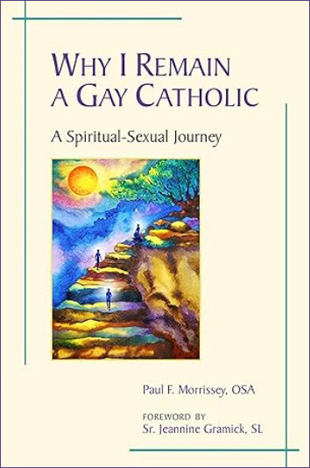
Excerpt from Why I Remain a Gay Catholic: A Spiritual-Sexual Journey by Paul F. Morrissey, OSA; Copyright © 2025 by Paul F. Morrissey, published by Paulist Press (www.paulistpress.com). Used with permission.