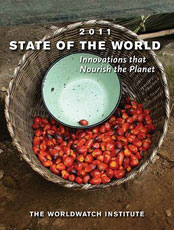
In the opening pages of this annual report, members of The Worldwatch Institute cover some of the events, legacies, and laments from October 2009 through September 2010. Among them are:
• "UN reports that 36 million people were displaced by natural disasters in 2009, with more than 20 million forced to move due to climate change-related factors."
• "Attendees at Rome's World Summit on Food Security renew their commitment to end hunger and emphasize agriculture's key role in feeding the planet's 1 billion undernourished."
• "Researchers say that distributing new varieties of drought-tolerant maize to African farmers could save more than $1.5 billion and boost yields up to a quarter by 2016."
• "UN General Assembly declares access to clean water and sanitation a human right, voicing deep concern that nearly 900 million people worldwide lack access to safe drinking water."
• "UN Secretary-General highlights the vital role of small-holders and rural producers in global food production and calls for new and varied partnerships to overcome hunger and poverty."
Olivier De Schutter, United Nations Special Rapporteur on the Right to Food, points out that anyone thinking about the role and importance of agriculture in a global context should realize how fragile our current food systems are; that climate change will significantly affect agricultural production; and that the production of food and eradicating hunger and malnutrition are two very different objectives. Hans Herren, president of the Millennium Institute, reveals that agriculture has its dark side as well: it "accounts for 70 percent of water withdrawals and 15 percent of greenhouse gas emissions — with nearly 75 percent of that emitted by developing countries."
But despite these daunting challenges, there is hope on the horizon. On a two-year program, Worldwatch's Nourishing the Planet team traveled to 25 sub-Saharan African nations and discovered innovative projects by farmer's groups, private voluntary organizations, universities, and agribusiness companies. They describe ways to safeguard local food biodiversity and cope with climate change, the importance of evergreen trees, the feeding of cities, harnessing the skills of women farmers, and much more.