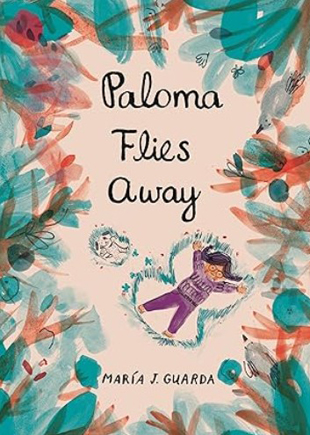
It's no accident that there seem to be an abundance of children's books now that cover the topic of child refugees. (See "Also Recommended" for recent examples among our reviews.) The United Nations High Commissioner for Refugees (UNHCR) estimates that in 2025 there will be 47 million refugee children worldwide. Children ages 6 to 9, for whom Paloma Flies Away is written, are likely to know refugees as classmates or neighbors — or to themselves be a refugee.
Paloma Flies Away is unusual among these books in that it comes full circle. Paloma has to make two transitions: leaving her country of origin with her family to escape a dictator and eventually, once she has adjusted to a new and much colder place, returning to her warm homeland.
The illustrations tenderly capture the parallels: Here's Paloma bundled up for winter in her new country, making snow angels; later, she's back home floating on her back in the sea with the same open posture. In both places, we notice her adorable skepticism as she scrutinizes drinks that are new to her.
The love with which Paloma's parents surround her throughout the story is palpable. We see her cuddled in her father's lap, her on the phone, as he points to a photo of the relative to whom she's speaking. And she reciprocates the love, noticing her parents' sorrow: "It was clear that they missed their country. A country I no longer remembered."
Touches of humor come through the family's interactions, too. At one point Paloma's mother braids her daughter's hair and the girl, looking in a mirror, says, "Mom, I look like a llama ..."
Chilean author and illustrator Maria J. Guarda conveys hope without glossing over the difficulties refugees face. It's heartening to remember that every so often, a child has the opportunity to say, as Paloma eventually does, "Now we don't have to say goodbye or pack. Not anymore."