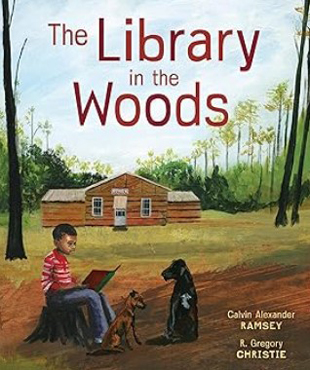
As a child, author Calvin Alexander Ramsey moved to Roxboro, North Carolina, where he had a library within walking distance for the first time in his life. The library, serving solely the African-American community, was a product of segregation, but Ramsey never felt second-best there: "The books were worn and the pages dog-eared, but each such page showed me that one of my friends had read the book before me."
The fictional account in this book is based on his experiences. When Junior's family is forced to move to town after their farm gets destroyed by a storm, his friends introduce him to the log-cabin library in the woods. A kind librarian encourages him to fill out a library card and tells him how to check out books. By the time Junior's friends are ready to leave, he's so engrossed in the library's many sections and the availability of books by Black authors that he tells them to go on without him. He chooses books not only for himself but also for his mother and father.
R. Gregory Christie's perceptive illustrations allow children to discover for themselves a love for books and creativity. One of the most moving paintings shows Junior's father in his truck at sunset, silently holding a book about the life of Dr. George Washington Carver that Junior has brought him from the library. We find out that he cannot read. What happens next, thanks to a conversation between Junior and his Momma, conveys an exquisite sensitivity and speaks volumes about the power of a library to build literacy in new generations.
Labeled for readers ages seven to eleven, The Library in the Woods has a broad appeal that can be tailored to younger children, who will be drawn in by the engaging pictures. It will also draw in anyone older who is interested in the era of history from the 1930s to the late 1950s when, as Ramsey writes in his Author's Note, "the hopes and dreams of little Black children were easily dashed, and yet we had hope and we had dreams that were fueled, in part, by our library."