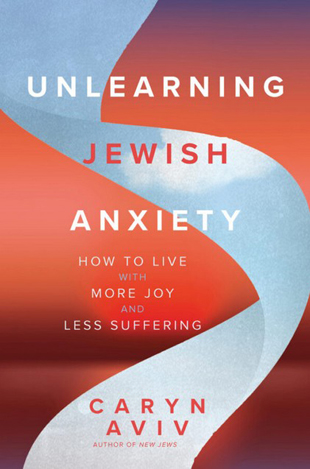
Whatever your perspective is on the war in Gaza, there is no question that the actions of the State of Israel have made Jewish life and identity in the diaspora (the rest of the world) much more complicated and difficult. Caryn Aviv could have written this book at any time in the last half-century, but as it is being published right now, it seems particularly timely.
Her thesis is that anxiety among Jews in the West is justified, because antisemitism is real, always present, and has recently gotten worse. But just as important, Aviv writes that much of Jewish suffering from anxiety comes from inherited trauma and history, and there are ways to address this in today’s Jewish life.
Chapter 1 looks at “The Neuroscience of Anxiety and Habits,” and Aviv strikes a balanced tone between using relevant science to explain human behavior, and then applying it in ways that guide the reader toward healing and hope. So, for example, just paragraphs away from each other we have “How we respond to fear and uncertainty from our amygdala are the first two pieces in understanding anxiety” — and “I invite you to take a moment now to reflect on your own experience of the four ‘Fs’ [fear, flight, freeze, and fawn]. Think of a situation (maybe a 4 on a scale of 1-10) where you felt uneasy, uncertain, or a little afraid. How did that fear or uncertainty show up in your body? What did you notice about your breathing, if you remember anything?”
There’s another whole chapter on “Safety, Worth, and Belonging,” which should dispel any notions that this author isn’t sufficiently concerned about protecting Jewish people. But then, after it, the final third of the book is full of spiritual practices for living with anxiety, even overcoming it, and moving toward a better way of life. These practices are rooted in Jewish sources and include “The Shema and Listening to the Breath of Being and Becoming,” a Jewish kindfulness practice, and “Shabbat for Your Nervous System.”
This book should help a lot of readers talk about the most difficult topics — and feelings — that have beset Jewish communities for centuries, and have gone largely unaddressed. As Aviv writes, “Through Jewish practices of pause, breathe, listen, and witness, we can create some space to discern what we need when we’re feeling triggered, scared, stressed out, and anxious, and make different choices than what we usually reach for.”