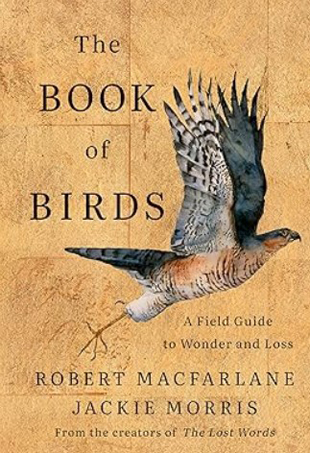
Notice the subtitle. This is not the field guide to birds that your father or grandmother kept on the table by the picture window. This one begins — the opening sentence — with: “A great thinning of the skies is underway.”
But it is mostly about attention, being present, and love — as when the authors explain two pages later: “Ours is a field guide with a difference, though. It asks not ‘What is that bird?’ but ‘Who is that bird?’ It wishes to help its readers to identify birds, of course, but also to identify with them. Instead of photographs — paint. Alongside data — metaphor, story, poetry. In place of definition — relation. As well as classification — something like love.”
It is also about wonder, which the authors do, and show us how to build the same capacity, through their careful attention to the winged whose presence is more precious than it has been ever before. They organize their 49 birds with seven in each of seven categories, each described as a kind of wonder. “The first wonder” is “Nest,” and after it come Egg, Beak, Song, Feather, Flight, and Migration.
Each of the seven sections begins with a few pages describing that “wonder,” often with more than a suggestion of how we might emotionally and intellectually connect with it. For example, “Flight” begins with “Each of us has dreamed of flying, surely?” And “Nest” begins: “To nest is to trust. To trust the earth to nourish the root that bears the trunk that grows the branch that makes the crook that holds the weave of moss and twig that forms the next that cups — pressed beneath a warm and beating chest — the egg.” Macfarlane is a beautiful writer (of previous bestsellers, too).
The book refers to both Macfarlane and Morris as authors, but in actuality, Morris is the creator of the gorgeous artwork that fills these pages, and Macfarlane is the wordsmith.
The bird species profiled include, in art and text, familiar names such as Cuckoo, Bullfinch, Kestrel, Lapwing, Puffin, Rook, Sparrowhawk, Swift, Tern, and Yellowhammer. The descriptions are all closely detailed, in a personal voice. “Great Skua” is the first bird presented under the wonder of “Beak” and it begins: “Skua, Skua, Evildoer, you’ve torn tongues from lambs, skewered eyes from calves, you’ve killed foals struggling free from their cauls. To other birds you’re Lucifer in feathered form, a blank-eyed brutal pirate of the northern seas.”
It is a larger, heavy book of 400 pages, more than worth the price, especially in these days when a thin paperback can easily cost as much. And the Latin species names are offered for each bird, too, so perhaps your father and grandmother would feel at home after all.