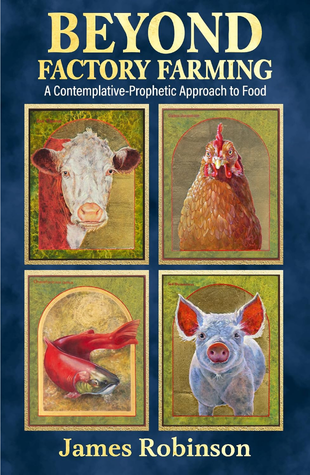
The late Buddhist teacher Thich Nhat Hanh wrote and taught on this subject for decades, and many Christian teachers have learned from Thay, and quote him. Now, perhaps for the first time in such sustained theological fashion, a Christian is covering similar ground—and going deeply into it. The result is a treatise aimed at convincing Christians to be more thoughtful about their eating practices; to let their values lead them.
Author James Robinson, a professor of religious studies at Iona University and longtime lay member of Catholic intentional living communities in the U.S., takes a loving approach amid a lot of serious consideration of topics such as factory farming, prophetic resistance, and panentheism. He does this by using the language of remembering: for example, “Turning Around, Returning to the Earth” is Chapter 1, and Chapter 2 is “Remembering Who We Are.” In other words, our eating practices have not been tracking with our values for quite some time. We can do better.
He quotes Thich Nhat Hanh, to be sure, but also frequently the Catholic theologian Elizabeth Johnson, the late great Catholic monk-writer Thomas Merton, the moral philosopher Peter Singer, and many others.
It isn’t a book for readers disinterested in theological discussion, or whose eyes glass over when academic studies and data are mentioned, and where phrases like “technocratic paradigm” are commonplace. (See the excerpt accompany this review for an example of what he means by “technocratic paradigm.”) This is a serious book for serious, willing readers.
The author wants to convert people; he’s very clear about this. To that end, for example, Chapter 17 is titled “Turning to Factory Farming in Order to Convert away from It,” and Part IV (of V in total) is aimed at creating “a constructive interpretation of eating as a contemplative-prophetic ritual rather than a merely habitual routine.”
Robinson believes he can convince you, and then show you, how to eat more sensitively, more radically, more subversively, more creatively, and more communally as a matter of faith and values, better informed, put into action. I hope he’s right.