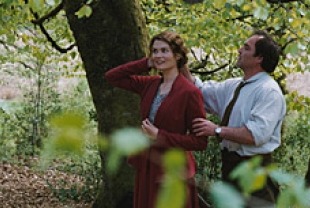
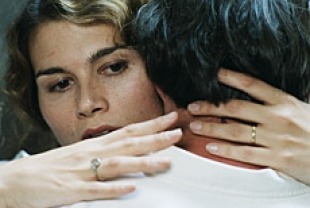
Constance (Marina Hands) is a lovely and still young woman when her husband, Sir Clifford Chatterley (Hippolyte Girardot), returns wounded from duty in World War I. Their lives are changed drastically by his having to spend the rest of his life in a wheelchair. He is a mine owner who believes the world has been divided justly between those who lead and those who follow. Constance tries her best to be his nursemaid but is worn down by her loneliness and the tediousness of her days. Her wealthy sister Hilda (Helene Fillieres) insists she see a doctor who finds nothing wrong with her physically but advises that she change her life and become more active.
Constance agrees to getting a full-time nurse for Sir Clifford, and Mrs. Bolton (Helene Alexandridis) fills the bill nicely. She looks after him with a professionalism that he admires and which convinces Constance that he is in good hands. Being a natural lover of the out-of-doors, she begins taking walks on the estate and happens upon the hut of Oliver Parkin (Jean-Louis Coulloc'h), the gamekeeper. The sight of him washing himself outside sends her into a state of shock. Constance has been so out of touch with bodies that seeing one in all its naturalness and fleshiness literally takes her breath away. She is like the character in James Joyce's Ulysses: "Mr. Duffy lived just a short distance away from his body." From this point on, Constance is a woman on a journey of sexual awakening seeking to connect with her erotic desires.
The connection between these two individuals is not a smooth one. She is rich beyond his wildest imaginings, and he is a humble man who enjoys his solitude. When Constance wants a key to the hut, he feels it is an intrusion on his privacy. She just wants a place to rest and loves being around the chickens and pheasants in the area. When she falls asleep one afternoon in a chair, Parkin is moved by her vulnerability and her ability to rest in his presence. He initiates their first sexual encounter on the floor of his hut. She has no regrets, and he is mystified as to what she wants from him. But all the same, he is pleased with the sex.
Co-writer and director Pascale Ferran has made a lyrical and enchanting film from one of D. H. Lawrence's most controversial novels. The unfolding of this drama is brushed by a slowness and a tenderness that touches the heart. Lady Chatterley was the winner of Best Film and four other prizes at France's Cesar Awards. It charts the spiritual transformation of Constance and Parkin that originates in sex but is enriched by the natural world that surrounds them and provides a wonderful playground for their sensual adventures. There are six scenes of physical love between these two, and they are handled with grace and beauty. In the one where they first climax together they are under a tree and immediately afterwards fall into a deep sleep. In another, he encourages her to probe his body with her hands. In a final one, they frolic naked in a downpour before having sex in the mud with the rain pelting their bodies. In a scene of exquisite tenderness, Parkin lays flowers on her naked body and places a crown made out of plants on her head.
These erotic excursions liberate both Constance and Parkin: she from the ivory tower of her loneliness and he from the prison of oblivion in the forest. They are both transformed by their intimate relationship, and it takes them on a path that ends with some difficult choices for each of them. The swirl of surprises in the last scenes of the film demand commitments that can only be made in the name of love.