“It is essential to experience all the things and moods of one good place.”
— Thomas Merton
A forest scene. A nest on a large rock. A dinosaur stomps on the nest as it runs through the forest. The land is covered during the Ice Age. An indigenous couple (Joel Oulette, Dannie McCallum) meet by the rock and welcome a baby there. A grand house is built nearby in the late 1700s for a relative (Daniel Betts) of Benjamin Franklin. In the 20th century the house is home to John (Gwilym Lee) and Pauline (Michelle Dockery) Harter; he chooses it because it is near an airfield. When he dies, the living room is the site of his funeral.
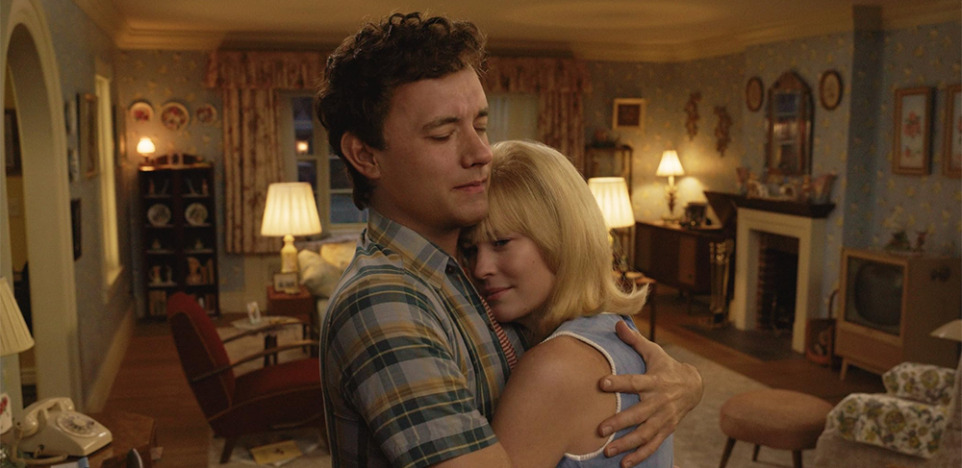
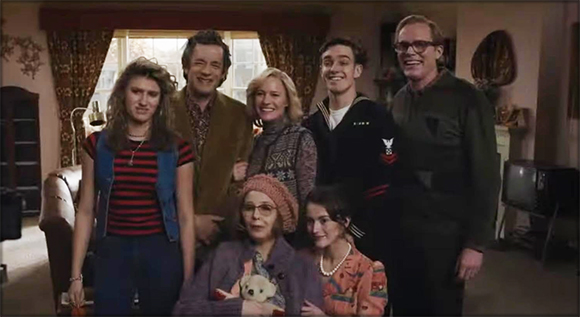
Later, in the same living room we meet the inventor (David Flynn) of the La-Z-Boy recliner who shows his wife (Ophelia Lovibond) how it works. After they leave, Al (Paul Bettany) and Rose (Kelly Reilly) Young buy the house and raise their three children there: Richard (Tom Hanks), Elizabeth (BeaGadsdon), and Jimmy (Harry Marcus). When Richard gets his girlfriend Margaret (Robin Wright) pregnant, they get married and live in the house, raising their daughter Vanessa (Zsa Zsa Zemeckis) there. When they divorce, Richard sells the house to a Black couple (Nicholas Pinnock, Nikki Amuka-Bird).
In the present day, Richard, now an old man, takes Margaret back to the house. She is in an advanced stage of dementia. But she remembers a special moment when they lived there.
Robert Zemeckis directs this story of what happens “here” on a single spot of land from the earliest times to the present day. It is adapted from a graphic novel published in 2014 by Richard McGuire. For the film, AI technology was used to age and de-age the actors for different periods. The screen is often divided into frames within frames so that we recall the things happening in the room over time.
Every place has a history. Every place has been inhabited by numerous beings. Every place bears witness to love and loss, birth and death, isolation and belonging. We just usually don’t think of a place’s history and predict its future. This film’s message was coined by Ram Dass: Be Here Now.
GOING DEEPER
To appreciate and nourish the soul of place is a spiritual exercise of great importance. We often take for granted the place where we live, love, or work. We forget that the ground we walk on is sacred. To get to know the place again, or perhaps for the first time, requires consecration and an act of imagination.
Steeping ourselves in a place, simmering in its bounties, celebrating its wonders, hearing its special music, and loving its peculiarities are necessary steps on a spiritual journey. Or as Wendell Berry has put it: “My most inspiring thought is that this place, if I am to live well in it, requires and deserves a lifetime of the most careful attention.”
Here are some ways to acknowledge and honor the soul of place.
- Become a local historian. Who were the first peoples in your area? Who followed them? What was their lifestyle? What imprint did they leave upon the land? What traces of them can still be found?
- Walk around the perimeter of your property. Stalk the place as if it were the first time you have ever seen it. What do you see, feel, hear, smell?
- Study the geography of the place. What geologic processes formed the land? What plants and animals are native to the area?
- Try a journal exercise in which you acknowledge each day a blessing coming from the place where you live.
- Set up a project designed to make where you live a more soulful place. It can be in the house, the yard, or the neighborhood.
- Consider how the weather affected the personality of the place where you live. Has that changed over the years?
- Look into the folklore connected with your community. How has place influenced custom, language, and tradition?
- Savor the literature, the poems, and the art created about the region you live in. Look for fresh angles on place and its poignant impact upon people.
- Remember who and what has tutored you in the pleasures of your place. What is the one thing you like most about it?
- If you listen carefully, you can hear the cries and complaints of a place. In what ways is your place suffering?
- Set up a house shrine consisting of objects, writings, or pictures which have special spiritual significance for you. Make it a place for quiet contemplation.
- Think about what mark you intend to leave upon your place. Do you see yourself as a caretaker responsible, as Native Americans put it, to the seven generations to come?