
 Do We Choose Joy or Does It Just Happen?
 Posted by
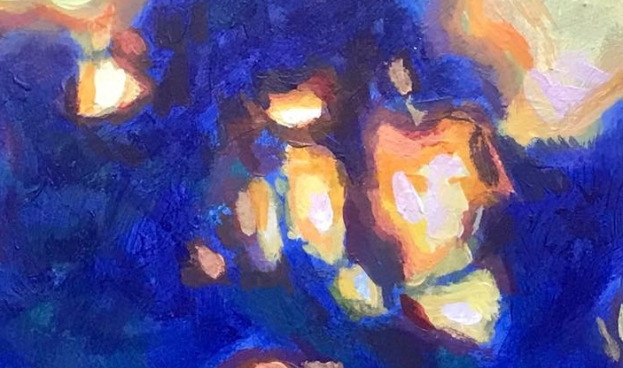
Cover artwork by Arina Stetsiuk, age 16, Ukraine
Written by Ananya Verma, age 15, India
The mind has an eye — an eye that often sees more than what our optic nerves may sense.
It doesn’t blink, nor does it need a source of light. It doesn’t capture the world as it appears, but how that moment made us feel. It’s like a lens through which we recall precious moments because of what they meant to us and how they impacted us at that point in time.
I’ve always perceived joy to be a feeling that comes and goes as it wishes, but perhaps joy isn’t what’s before us but rather what our mind’s eye chooses to see. Maybe joy isn’t a place we accidentally discover, but a path we choose to walk.
When I began writing this, I had beside me a spiral-bound diary that I decorated at the age of seven, using a marker I didn’t realize was permanent, and a notepad I didn’t know belonged to my father.
That diary reminded me of how I crossed out the cover-page title, “Public Policy,” without a second thought, and boldly wrote in the center, “Ananya’s Diary,” complete with a smiley sticker.
Writing down my name, in its correct spelling too, filled me with happiness, but what truly made me laugh — then, and even today — was my father’s reaction. When I reminisce about that moment, I think he must have been surprised (perhaps not in the best way), but for me it was the very first time I discovered joy.
Before moving ahead, let me ask you a question: When you were younger, how did you know that celebrating birthdays — hosting a party, cutting a cake, or unwrapping presents — was supposed to be fun? How did you know that playing with your friends in the park or going out for a family dinner was meant to bring you joy?During childhood, we don’t instinctively know which occasion is, or isn’t, symbolic of happiness. In fact, we are taught by the people around us. It is through their excitement that we learn that dressing up for Halloween as a ghost by cutting two uneven holes in a white sheet is fun, or playing board games with loved ones is wholesome. We absorb the idea of joy — an idea that helps us seek and understand joy for what it’s meant to be.
In a student’s life, very few things in the world can match the joyful moment of marking the end of the final exams on your calendar, and eagerly planning the long-awaited vacation. Recently, my family and I took a road trip to Nepal at the end of my academic year. The six-hour journey was nothing short of mesmerizing — looking out to a landscape of scenic beauty, I couldn’t help but feel engulfed in the serenity of the folding mountains and perennial rivers.
What attracted my attention the most was the simplicity of the lives of the people. Almost every hour or so, we would make a stop at the roadside stalls selling chia (“tea” in Nepalese) or fresh fruits and talk to the people there. Their occupation wasn’t driven by commercialization, nor were they trying to maximize their profits, and they were so beautifully happy. It was incredibly touching to see their kindness, their warmth, and their fundamental view of life and spiritual connections with their environment.
As we drove past the little towns, my father mentioned a neighboring country where happiness is more valued than money. He said Bhutan has a GNH Index, or Gross National Happiness Index, meaning it measures the happiness of its people to determine its progress. I found it astonishing that a country believes that its prosperity lies not in its economy’s wealth, but in the joy of its citizens!
Clearly, joy and happiness are beyond a sense of contentment or material wealth. Joy is a deeper, more intrinsic emotion; it lies within each of us. It is not about what exists out there in the world, but about what lies within each of our hearts.
So now, for the real question: Do we choose joy, or does it just happen? For me, the answer is: Both.
Joy can come unannounced, in moments that catch us off guard — when we witness something pleasant and unexpected, when we are awestruck or inspired. Many times, we exercise a certain control over ourselves; but it is in those rare moments when we surrender, when we let go — of expectations, of fear, of that control — that we find joy, when we let our spirit ebb and flow freely, untethered.
If you wake up early, and the sun decides to wake up with you, it’s pure joy — watching the sun illuminate the sky with colors no camera can ever capture, and only a heart can truly remember. For those few seconds, everything is quiet, still and suspended, and yet so fulfilling.
Joy can also be found in the smallest of things: when your favorite song starts playing in a café, when a dog wags its tail upon seeing you, and even when you’re dancing in the rain, letting go of every pain, loss, or sorrow you ever felt.
Sometimes, though, joy has to be chosen, and by chosen, I mean cultivated.
There are days when the weight of responsibility becomes overwhelming — assignments, school work, being unable to make time for things we love. When the world around me feels loud and burdening, I simply hit the pause button.
I’m not with anyone, and yet I’m not alone. In those moments, I don’t have a destination, nor am I chasing one. I choose to release the pressure and slow down, and in that process, I stumble across my good old friend, joy, once again.
Joy is a state of mind — a way of being and living. It may not always be found, but it can be pursued — by investing time and effort in nurturing relationships, discovering a hobby or a passion, and by mindfully letting go of negativity and enjoying the spontaneity of the journey, rather than just focusing on where we have to be.
Sometimes, life isn’t about chasing happiness or joy, but about choosing to open the doors for it. Joy can simply happen, provided you let it happen.When I hear the words “let go,” I liberate myself from my physical surroundings. Time may not stop for me, but, for those few seconds, which may not come again, I stop time for me.
The most beautiful thing about joy is that it doesn’t demand any attention, but when it arrives and you let it in, you will remember what being alive feels like.
At the time of publication, Ananya Verma was a 15-year-old studying at Springdales School, Delhi, in India. She loves to write and express herself through stories and poems. She also composes songs.