According to the U.S. Bureau of Labor Statistics 2003 Consumer Expenditure Survey, the average American spends 18 cents of every dollar earned on transportation. And 98 percent of that transportation spending is for "the purchase, operation, and maintenance of automobiles." Other research shows that Americans spend a big chunk of their income on cars: it costs $8,410 a year (roughly $700 a month) to own a vehicle according to a 2004 American Automobile Association study. That figure includes car payments, insurance, gas, oil, car washes, registration fees and taxes, parking tolls, and repairs.
Nearly 17 million new cars are sold in the United States each year. That's more than 45,000 every day, or one every two seconds. They gobble up natural resources and create pollution. Yet $20 billion of automobile advertising every year would have us believe that buying or leasing a car, truck, or SUV is the wisest and most natural thing we can do. Not only do cars devour our money, they consume our time, squander our mental and physical energy, force us to sit in traffic jams, deteriorate our health, and cause us to risk serious injury and death every day.
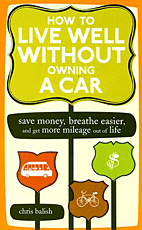
Chris Balish lives in Los Angeles, California, and is an award-winning feature writer, reporter, and broadcast journalist. He commutes by bicycle year-round and travels all over on foot, on mass transit, and by carpooling with friends, girlfriends, and coworkers. In this well-presented paperback, Balish proves that living without a car can improve your quality of life.
Shifting from a car-dependency to a car-free or car-lite lifestyle does require making some changes, and Balish discusses the six keys to car-free living. In a convincing chapter, he outlines the financial, lifestyle, physical, and emotional benefits of giving up car-dependency. It can give greater peace of mind, lower your stress level, improve your health, eliminate hassles, provide more social interaction, and maybe result in more free time.