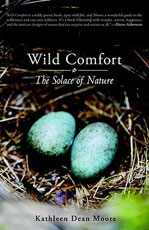
Kathleen Dean Moore is the Distinguished Professor of Philosophy at Oregon State University where she teaches courses in environmental thought and ethics. As an essayist and activist, she brings together natural history, philosophical ideas, and creative expression in a search for lasting, loving ways to live on Earth. This marvelous and sense-luscious collection of essays demonstrates her distinctive style which is rich in descriptive passages and deep musings. In the introduction, Moore explains seeking the solace of nature after a series of deaths which made her life "an experiment in sadness." She went on a quest to learn what nature could teach her about sorrow and gladness in lush forests, wild rivers, faraway deserts, and islands. Her companion on these journeys is her husband Frank, a biologist.
Moore is quiet while listening carefully to the wisdom of snakes who carry a hint of gladness. Wonder is aroused when she sees for the first time the blue flash of sardines in the water. While wandering in a forest, she looks attentively at some trees with snow on their branches that "lean under their heavy loads as if they are praying." In a green field, she tries to squeeze some meaning out of geese in the sky. Less serious, Moore explores five fun things to do with stones at the edge of the water anywhere in the world. There is awe and delight in her description of witnessing a flock of butterflies drinking from a patch of mud. At the end of this essay, she writes:
"Humans are Earth's way of knowing itself. With the tongue of a human being, Earth tastes itself. In a human's search for meaning, it comes to know its own mysteries. In a human's loving attention, Earth rejoices in its own beauty. It's one thing to be. It's quite another to know that and to pronounce it good. This is what a human being brings to the world — the ability to take notice, to be grateful and glad, glad for the river swinging by, for the sun warming my shoulders, for the breeze lifting the hairs on a butterfly's back."