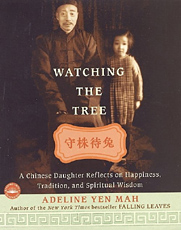
Adeline Yen Mah has lived and worked as a physician in California for 30 years. In this follow-up to Falling Leaves, her memoir set against the backdrop of political and cultural upheaval in China, the author looks at some of the foundation stones of this ancient civilization. She dedicates Watching the Tree to her grandfather and calls it "a paean to his humanity and knowledge."
Somewhere it is written that every Chinese wears a Confucian thinking cap, Taoist robe, and Buddhist sandals. Over the centuries these three religious traditions have managed to coexist in the world's oldest living civilization. Change is seen as the only given in the Chinese mind.
Adeline explores the enduring popularity of the I Ching as a tool for soul-searching and self-analysis. She gives a substantive overview of the achievements and flaws of Confucianism as a way of life built upon filial piety. She also includes overviews of Taoism, Zen, yin and yang in harmony, and the invisible energy of feng shui.
According to Chinese tradition, the four ingredients of happiness are health, congenial relationships, gainful employment, and appreciation of life's blessings. For many Americans, the Chinese way of viewing things still remains inscrutable. Adeline Yen Mah's Watching the Tree doesn't unravel all the mysteries of Chinese wisdom but it does shed light on the essential building blocks of Chinese culture.