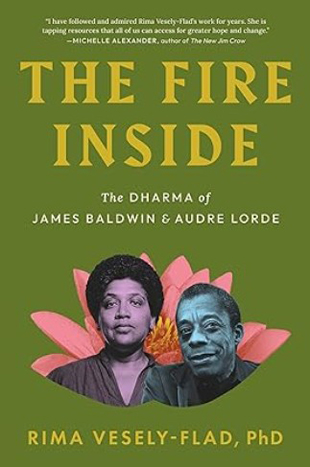
This exciting younger writer opens up new ways of reading the great novelist and activist, James Baldwin, and the great philosopher-poet and activist, Audre Lorde, by looking at them together through the lens of Buddhist teaching (dharma) on liberation.
Their shared vision is shown to be urgent for the present time. And Vesely-Flad adds her own story to the mix, beginning in the Introduction when she writes about the two figures: “They were unshakable, protective. I was increasingly aware of what it had taken for them to attain such strength. Like them, I had come up against a rigid, conservative theology in my home; I had been hated by members of my family. I had been abandoned by my father. I knew what absence meant. Yet, through books, I had learned to imagine something else: another way of being, another world to live in.”
Rima Vesely-Flad is a PhD who has taught at Warren Wilson College and Union Theological Seminary, and authored two previous books with scholarly presses. She’s also the founding director of the Initiative for Black Buddhist Studies — a public scholarship project created at the intersection of academic inquiry and community-based engagement. They organize events, publish a newsletter, recommend resources, and present succinct teachings and spiritual practices in the form of a podcast available on Spotify and their website.
Vesely-Flad resonates with the teachings, practices, and witness of these two great American authors and activists, pointing out how deeply Buddhist their approaches are and how they have informed her own Buddhist understanding and practice. Audre Lorde, for example, is shown to honor suffering in how “turning toward feelings, regardless of how excruciating or vile they might seem — leads to a capacity to acknowledge harm without shutting down.” And James Baldwin, “who never identified as Buddhist, was nevertheless the voice that helped me to embrace Buddhism as relevant to the particular experiences of Black people in the United States … help[ing] me understand the task of acknowledging our conditions and the delusion that arises from them.”
Every chapter concludes with one or more spiritual practices, and these are often written with the help of other teachers with whom Vesely-Flad is connected — such as Justin Miles, Ruth King, Gabrielle Roth, and Valerie Mason-John. Some of these are quite detailed, but helpfully so; see the excerpt accompanying this review for an abbreviated version of one.