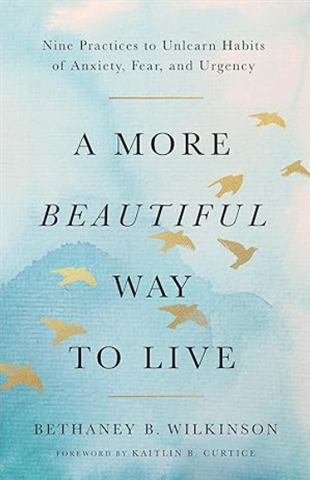
The pandemic only deepened in us what was already there: tendencies to over-work, over-stress, over-achieve, over-think, and worry. Wilkinson is finding ways to counter these things in her life, and sharing them with readers in this creative first book of hers.
We found her teaching on “slow time” the most helpful of all. It fills Chapter 1 as a way of framing what follows. “Slow time is every moment we choose to be fully present and radically attentive to life’s unfolding in the here and now.” This is of course not a new idea, but the author has a way of using her own experience, as well as the experiences of others, to make the teaching real and approachable for readers who — most of us, probably — glide over such words often without taking them fully in, let alone adopting them as practices in our lives.
One analogy she uses for slow time is the planting of a garden. “Before planting anything, we have to survey the landscape to see what is. What is the quality of the soil? What is the pattern of the sun moving across the sky?... What wildlife lives nearby and may be in relationship with whatever is grown here? Only in answering these questions can we rightly determine what seeds, trees, or types of vegetation can thrive in that particular patch of earth. Slowing down your life is carving out space to be honest about what is so that you can then plan for what might be.”
Chapters 2 and 3 offer helpful guidance for “Connecting with Your Body” and “Awakening to Your Inner Terrain.” Chapter 4 looks at the seasons of the year and their changes as opportunities to grow and understand oneself and the world. Along the way she quotes some familiar teachers from a generation or two before her, including Brene Brown, Richard Rohr, Christine Valters Paintner, Parker Palmer, Stephen Covey, and Julia Cameron. Wilkinson communicates very well, selects sources creatively, and guides the reader toward helpful suggestions for new life.