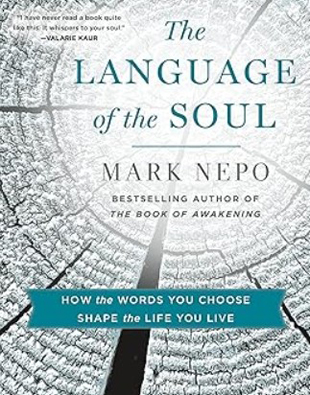
Mark Nepo has written another classic. The author of The Book of Awakening and Drinking from the Water of Light turns to his love of words and how they sometimes combine to reveal keys for awakening meaning in our lives.
This is a word lover’s treasure. Nepo has located 228 “words, phrases, and mythic notions—gathered from thirty-one languages and traditions” that, together with his pointing, examples, and illustrations, might “serve as a comfort and source of strength, and offer you a sense of home in the days ahead.”
The 228 are categorized into themed chapters such as “The Nature of the Soul,” “Commitments to Living,” and “Correcting the Missteps That Keep us from Living.”
Each of the 228 is called by Nepo “a word cluster” as he pins together words that might not obviously go together, but then he shows how they do. In the first one, for example, the religious traditions of Judaism and Sufi Islam are represented as Nepo examines the combination of “become” and “blessing.” Each cluster then concludes with “A Question to Walk With,” such as this for “become” and “blessing”: “In your journal, describe one way you’ve still becoming, and one way you are still unfinished. Later, in conversation with a friend or loved one, discuss how your process of becoming is giving you more life.”
Aramaic, Pali, Hebrew, Yoruba, Sanskrit, Hindi, Yiddish, and Japanese are some of the languages from which words come in the opening chapter. One of its clusters includes four words — from Hindi, Hebrew, and English — centering on what it means to perceive and receive; about which Nepo writes: “Our movement between numbness and wakefulness is an unavoidable part of being human, a cycle we move through again and again. Once we accept this rhythm of closing and opening, we can recognize the signs…. This is the art of the additional soul: to stay devoted to what will put us to sleep and what will wake us.”
At times, the clusters and the ways Nepo interweaves them toward meaning are simply stunning. For instance, late in the book he turns to this cluster: “jihad, idiot, embarrass, lost, todatsu.” The last word is Japanese. For a summary of how he reveals its meaning, see the excerpt accompanying this review.
Occasionally, a cluster is deeply personal, related to Nepo’s unique journey, and so he includes a story from personal experience. One of these comes when he pulls together “theater,” “vulnerable,” “veteran,” and “war,” and describes a psychodrama class he took with his cancer support group, led by a Jungian priest. The point of his story is that we carry wounds, and sometimes we carry them gracefully. And, as always, he makes it relevant to readers with guided questions at the end.