This is a book about listening, and not just the physical kind. It's also about listening to our own needs — and, as we meet them, listening for the needs all around us that we might compassionately try to meet, just as Dr. Robert B. Irwin did when he invented audiobooks.
Due to a fever that inflamed his eyes, Robert lost his sight at age five. This misfortune "didn't stop him from finding new things to discover. He could hear the splash of the surf on the shore, the squirrels skittering in circles around the trees, the crunch of leaves beneath his feet.... Robert focused on what he could do and continued to find new ways to learn."
His school had no experience with blind children, so he left his family for a boarding school that taught finger-reading with raised text. But he wished he could listen to a story whenever he wanted. What if books could talk?
After working his way up through an M.A. from Harvard, he became a superintendent in the Cleveland, Ohio school system, providing blind students with all the materials they needed for reading. Then the newly organized American Foundation for the Blind (AFB) invited him "to use his expertise to explore more ways to improve the lives of blind Americans." This led to his discovery that few blind readers were interested in borrowing library books and that "the problem wasn't the readers — it was the books." He knew that what they needed was his childhood dream: talking books.
Robert persevered through disappointing early attempts and eventually produced not only talking books on special records, but also convinced many people to donate small amounts of money, raising enough to make six hundred machines that could play the records. These machines made such a difference in people's lives that the AFB received feedback like, "Life without one would be intolerable" and, "As I wait for the records to come, I am not unlike the children waiting for Santa Claus." Soon other people discovered the joys of audio books, "all because Robert discovered what he could do."
Author Jenny Lacika was originally drawn to this story because she loved audio books as a child. She began writing for children "after I was diagnosed with multiple sclerosis and struggled with fatigue and cognitive changes that made my former career more of a challenge." Now she loves writing so much that she can't imagine doing anything else. Her work often explores themes relating to education, disability, and accessibility, as well as Chicanx culture and history.
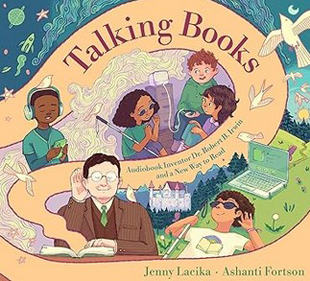
Ashanti Fortson's illustrations give us a walk through history, with changing landscapes, clothing styles, and technology. She conveys a strong sense of words' impact as they wind on ribbons through the pages or appears as colorful sounds that a child might hear in the summer ("EEK! A BUG!" or "splish splash"), and she shows the leaps in confidence and happiness in readers' faces and demeanor when they happen upon the pleasure of audiobooks.
Written for four-to-eight year olds, Talking Books has much to offer any reader seeking to turn their own apparent losses into a benefit for self and others — or simply wanting to know the story of a man to whom we owe so much.