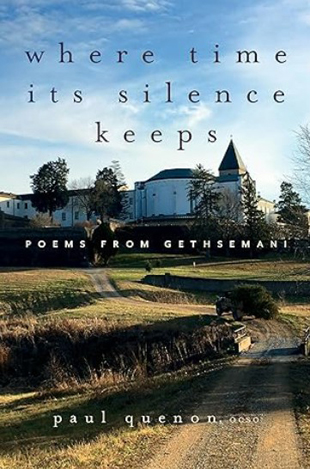
The marketing copy for this book reminds readers that there have been other great monk-poets going back at least to the ninth century in the figure of Hanshan, a Chinese Buddhist. His name means “Cold Mountain,” and perhaps you’ve seen Hanshan’s “Cold Mountain” poems.
There also were Zen Buddhists and sometime monks Philip Whalen, Leonard Cohen, and Gary Snyder. Snyder is still with us; we reviewed his collected prose just last year.
But here we have the most important Catholic monk-poet of the last half-century; long ago Paul Quenon, OCSO, picked up the pen his novice master, Thomas Merton, left when he died in 1968. Quenon is now 84 years old. You may know him best from his memoir of several years ago, In Praise of the Useless Life.
Thomas Merton was sometimes ponderous in his poetry, and often self-consciously modern as well as political. Quenon, by contrast, delights in the natural world, pokes fun at himself and other monks, and sings. These are poems of wonder, play, and joy.
But also, they are filled with a mystical Christianity. Here, in the poem “Impossible Worship,” he sounds like Meister Eckhart:
“Adoration, all, hindered
by Divine presence
in thick smoke and cloud.
“No hands stretched toward
One imminently present,
One too near to be touched.
“None can worship when
possessed wholly by God—
God who never worships.
“Enough to be still
and know God with
God’s own knowledge of God.”
But most often the poems are lighter, including one on “Ridiculous Prayer,” as well as poems about birds and the moon, and some delightful haiku on creatures including this one, my favorite:
“Happy rabbit runs
figure eights around two shrubs—
morning’s big warmup.”
It is clear, always, that Quenon writes of what he sees and knows, firsthand.
And this probably includes “Searching End of Night,” when the poet speaks of leaving mass on a winter morning with the moon still high, going “to search inscrutable night.” It ends with: “Yet onward I search / sensing—as long as I search, I find.” Those two lines might describe this book as a whole and the monk-poet who wrote it.
Finally, after 120 pages of poems there is an interview with the poet. It is that interview which we excerpt to accompany this review. Highly recommended.