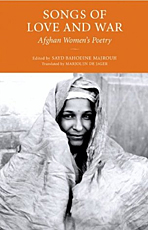
The late Afghan poet Sayd Bahodine Majrouh went into exile in Peshawar, Pakistan, after the Soviet invasion of Afghanistan. He was widely seen as the literary heir of Rumi and Omar Khayyam after the release of his epic Ego-Monstre. He was assassinated on February 11, 1988. He had been gathering songs of anonymous Afghan women since the time of the Soviet occupation of the country. This brand of oral literature is called landay, which literally means "the short one." According to Majrouh, it is "a very brief poem consisting of two verse lines of nine and thirteen syllables respectively, without any obligatory rhyme but with solid internal scansions. . . . Like a cry coming from the heart, a lightning flash, a flame, the landay captures the attention by its brevity and rhythm." These brief poems and the explanations of the lives of the ordinary women who composed them has been translated from the French by Marjolijn De Jager.
It is quite shocking to read about the terrible plight of Afghan women. They live as slaves to men and the clan. Their days run from before dawn to deep into the night and their responsibilities include getting water twice a day from the spring or a river, taking care of their children, cooking, cleaning, and looking after the cattle. What pains them the most is not this backbreaking physical labor, but "the moral side of their subjugation" which consists of being treated as second-rate human beings every moment of their lives.
At their birth, fathers seem to go into mourning whereas when a boy arrives, there is a great celebration including a salvo of gunshots. Girls spend their early days in a constant "state of inferiority, subordination and humiliation." Many of these landays chart the suffering they experience in marriages to young boys or old men. For example, here is one: "Oh my God! Once again you send me the dark night. / And once again I tremble from head to toe, for I must get into the bed I hate." And if they ever do fall in love with someone else, it is punishable by death. Following the custom in the community, adolescent boys assert their manhood by beating their mothers. The poetry in this collection conveys the anger, the anguish, the shame, and the slow death of these Afghan women.