
“Every advance in medical capabilities is an increase in our moral responsibility.”
— Dr. Joseph Fletcher
According to the National Survey of Family Growth of the CDC, among women ages 15–49 in 2015 – 2019, living with men, 13.4% had impaired fecundity – i.e. difficulty conceiving or bringing a pregnancy to term. Many had pathology of the fallopian tubes or other parts. Infertile couples may go through years of testing and even surgery before giving up hope of having children.
This prognosis changed when researchers in England were able to offer women the option of in vitro fertilization. A doctor surgically removes egg(s) from a woman’s ovaries. The eggs are then fertilized with sperm. The resulting embryo is transplanted back into the woman’s body. Although this procedure is widespread and recognized today, in the beginning the researchers and the woman cooperating with them faced opposition from other doctors, religious institutions, and families.
Joy is a biographical film about three people who were instrumental in developing the technique and, consequently the world’s first in vitro fertilization baby, Louise Brown, in July 1978. It is a true story.
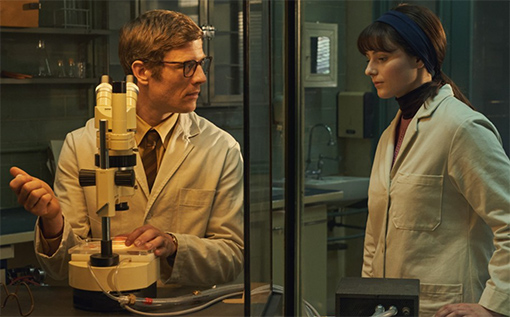
James Norton plays Dr. Robert Edwards, a British physiologist. He recruits Jean Purdy (Thomasin McKenzie) as his lab assistant, and together they convince obstetrician and surgeon Patrick Steptoe (Bill Nighy) to join their team. After Robert speaks to the press, he is called Dr. Frankenstein. Jean’s mother, a devout Catholic, argues that she is playing God; their family priest asks Jean not to come to services, and her mother tells her not to come home. Jean argues that they are only giving women a choice.
There are medical setbacks as well. After having an embryo implanted, one woman has an ectopic pregnancy; another has excessive bleeding. The team makes adjustments in their solutions and timing of treatment to a woman’s cycle.
This story comes across as a medical detective story. What will work? What won’t? Why? It is also the story of the determination and resilience of the medical professionals and the women they are treating. And finally, it is a story about dedicated people who are willing to make personal sacrifices so that others can have what they desperately want. They are pioneers and servants.
A slide at the end of the film points out that some 12 million IVF babies have been born.