
Four stunningly crafted human lives lie at the center of Jochaim Trier’s Sentimental Value, but the main characters are actually the spaces that hold them and the spaces that lie between them. Taking place mostly within the walls of a beloved house that has seen the epic highs and the devastating lows of its inhabitants through decades of familial and global wars, this subtly searing tale takes on universally applicable power by portraying the very specific travails of one fractured family.
We first meet bright young actress Nora (Renate Reinsve) as she prepares to perform for a packed theater. It’s immediately apparent that something is wrong; she’s doing everything she can to not go onstage, only finally entering after a fellow actor (at her request) slaps her across the face. Nora’s therapist mother has just died but the grief surrounding this loss is just the tip of the emotional iceberg keeping her frozen. The architecture of her relationships with her quietly competent sister Agnes (Inge Ibsdotter Lilleaas) and famous, distant film director father Gustav (Stellan Skarsgård) is shaky at best and crumbling at worst.
In the wake of the funeral, Gustav reveals that he’s composed his next project, a fictionalized exploration of his own mother’s death by suicide, as a star vehicle for Nora. But Gustav has a history of regularly abandoning the family and Nora, seething with pent-up resentment, will have none of his artistic olive branch-waving. Following her refusal, Gustav engages the talents of bona fide American movie star Rachel Kemp (Elle Fanning), but Rachel’s inability to land the authentic heft called for puts the future of the film into question. That is, unless someone who actually knows how to actually live within the walls of the film’s fragile framework, namely Nora, will agree to let down her own walls and take on a role only she can play. Meanwhile, it’s also time to get rid of the very home that has always kept their bruised hearts sheltered through every upheaval.
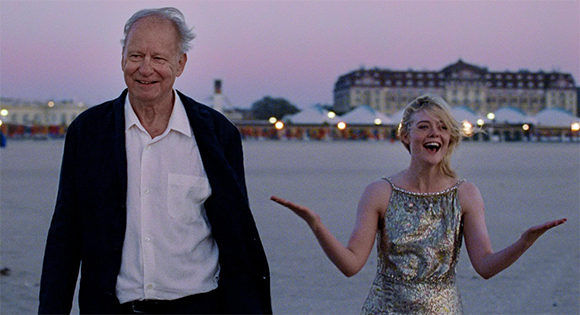
The particulars of the plot are always compelling and often hilarious, especially for those who appreciate witnessing the inner workings of fraught creative collaboration, but Trier’s metaphysical interests stretch far beyond each grounded material moment. Using the house that these characters have loved, hated, and stubbornly cared for as a central metaphor, Sentimental Value highlights the paradoxes that permeate the scarred shared spaces that are both firmly rooted in solid foundation but regularly threatened by creeping fault lines. It also sensitively plumbs the pain of the distances that grow wider through inattention and lack of intention, even and especially between folks who are often existing only a few feet away from one another.
Ultimately, both Sentimental Value and the film being made within it are about abandonment, the ways we abandon one another and the ways we abandon our own paths. They are also about reconnection, how we avoid or name past traumas and how the former holds us back from the rebuilding that the latter might make possible. Relationships and houses rely on a certain sturdiness to their scaffolding to keep them standing even when seemingly irreparable damage has been done. Sorting through what can be mended and what must be discarded is not only the fraught work of artists but the work of every human being who hasn’t stolen away to a solitary hermitage.
As poet Gwendolyn Brooks says,
“we are each other’s
harvest:
we are each other’s
business:
we are each other’s
magnitude and bond.”
Relationships, whether they be within a biological family or within the larger family of all things, are maddening and mystical. They require a regular interest in both introspection and outreach, a willful willingness to both hear the harm we have caused and to heal the harms we have incurred, the type of trust that calls us to both truly know when it’s time to throw something away and what it means to offer it one more once-over, just to see if something, anything can be salvaged.