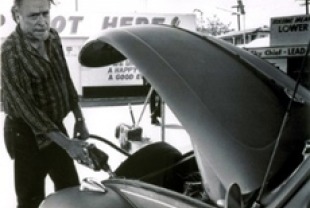
Charles Bukowski (1920 - 1994) has been called the twentieth century Walt Whitman — a people's poet and novelist who was acquainted with hard times, terrible jobs, and living in poverty. He was born in Germany and raised in Los Angeles. Bukowski barely survived the regular physical beatings he received at the hands of his father, and he was always an outsider at school due to a disfiguring case of acne vulgaris. But he was saved by a love of writing and an interest in literature. He didn't have sex with a woman until he was 24. Asked in an interview to define love, he obliges and says, "Love is the morning fog that burns away quickly."
During World War II, Bukowski roamed America on his own private pilgrimage. He wrote stories but they were rejected by the prestigious magazines he admired. The author nearly died in 1956, after years of unrelenting drinking. Bukowski was more successful when he started writing poetry; many publications picked up his work and he earned the title "king of the little magazines." Many ordinary people connected with his direct style and his "anecdotal voice narrative poems."
During these years, he got a job working at the Post Office since his writing never paid enough to support him. He hated his boss, sloughed off as much as possible, and railed against the rules and regulations. During the 1960s, Bukowski stumbled into even more acclaim when he wrote a column, "Notes of a Dirty OId Man," for the L.A. Free Press, a counterculture newspaper. John Martin, the founder of Black Sparrow Press, was convinced that the time was ripe for the broader American public to sample the diversity of Bukowski's writing so he offered him $100 a week for life to free him up to do nothing but creative work. The author produced a prodigious outpouring of novels, poetry, memoirs, and short stories until his death at age 74 of leukemia.
First-time director John Dullaghan has fashioned a richly detailed and dramatically delivered documentary on this prolific, cranky, colorful, misogynistic, blunt, self-destructive, and disciplined writer who traveled the long hard road from a hellish life in skidrow to the life of celebrityhood. He has gathered extensive footage from diverse interviews with Bukowski and commentary by his wives, colleagues, and friends including Sean Penn, Bono, Tom Waits, Taylor Hackford, and Barbet Schroeder. What emerges from all this effort is a spunky portrait of a writer who persevered and left a legacy larger than anything he ever could have imagined.
Special features include a commentary by director John Dullaghanm; a sneak peek at previously unpublished poems & "Dinosauria, We"; "Born Into This" behind-the-scenes featurette; Bukowski's final home footage from 1992; a deleted scene; extended interviews with Bono, Linda Lee Bukowski, Taylor Hackford, and Publisher John Martin; and Tom Waits and Bono read Bukowski poetry.