If you follow the polls predicting who is leading in the United States presidential race, you probably do so to see if your candidate is ahead or behind, and maybe to gauge whether or not to give a little money, write some postcards, or do some canvassing.
When you see that your candidate is ahead, you probably feel relieved and maybe a bit more able to imagine what your life will be like after November 5, 2024.
I think in these last weeks of the election cycle, it is good practice to look at the polls in a different way: not as an indication of who will win or lose, but as an indication of who we are.
We have two very different candidates. Donald Trump represents one version of the United States of America and Vice President Kamala Harris represents another version. Roughly 48% of the voting public is fighting for the country behind Door #1, and roughly 48% of the voting public is fighting for the country behind Door #2. (And millions of Americans feel too politically disenfranchised to pick a door at all.)
There is no 60-40 split. Whatever happens, there will be no overwhelming winner, no consensus, and no clear way forward. There will just be continued fighting.
We are two Americas, red and blue, despite the soaring rhetoric of a much younger Barack Obama in a more hopeful time.
Two Americas.
The outcome of the election will determine a lot politically, and there will be real consequences. No doubt.
Some of us may feel like our version of America won and the other version of America lost.
But I fear we are far beyond that simplicity. After November 5, we will have a president-elect, but the country will be in the same mess. We will still be an America divided. Our collective lives after election day will be as fraught as they were before November 5.
So, what do we do?
Well, first, let’s be very specific. We are divided about politics. And though it can for good reason feel like everything is political these days (who knew we could argue over weather?), we are not split on everything.
That can be hard to believe because we have let politics take over. But I think we might be surprised how far afield from politics we can remain if we just don’t lead with it.
I have been on a social media break, but I glanced at my neighborhood page on Facebook yesterday, and this was the first thing I saw, a post from the group administrator: “HEY! Stop being rude to each other on political posts or risk a 28-day suspension. Seriously.”
I scrolled through some comments and, apropos of nothing (which was the point), a man named Mike had posted a picture of a lake he had just swum in in the Eastern Sierras.
I don’t know Mike, but I decided to reply, “This is my favorite thing to do, just jump in bodies of water. This time last year, it was a cold plunge in a lake in the Wisconsin woods.” And I posted a picture of that very cold lake.
No one asked for my input. I didn’t know the people in the comments section. The interaction was random and superficial, and it may stop there. It was just an experiment.
But now I know Mike and I share my favorite thing in the world to do, and if we ever do a cold plunge together, our voting record is not going to come up as we try to keep our internal organs from freezing!
It’s time to commit to having superficial conversations. Not every conversation or connection needs to be deep and based on shared values and agreed upon ways to live them out.
When we don’t lead with politics, or have politics as a subtext or background, we can find things to bond us.
At first, we might have to have some really dumb conversations.
Person #1: I like sunny days.
Person #2: Me too.
Person #1: Would you like an almond?
Person #2: I love almonds!
Dumb, basic, but very important. Casual bonds are key to wellbeing and to the connections necessary in a democracy.
If it helps, we can pretend that we are in second grade again. (Some religious teachings call us to be more like children, after all.) We can talk about our favorite colors and foods. We can play games and do crafts, things that focus our minds on the same task.
And we can ask questions. Lots of questions.
Do you like the work that you do?
Where would you like to travel?
Do you ever make things with your hands?
If the idea of seeking out really basic conversations as a way to strengthen democracy feels silly . . . good!!!
Silly is so much better than contentious, alienated, and rigid.
Elementary interactions across the red-blue divide may feel awkward and forced, but social embarrassment is preferable to national collapse.
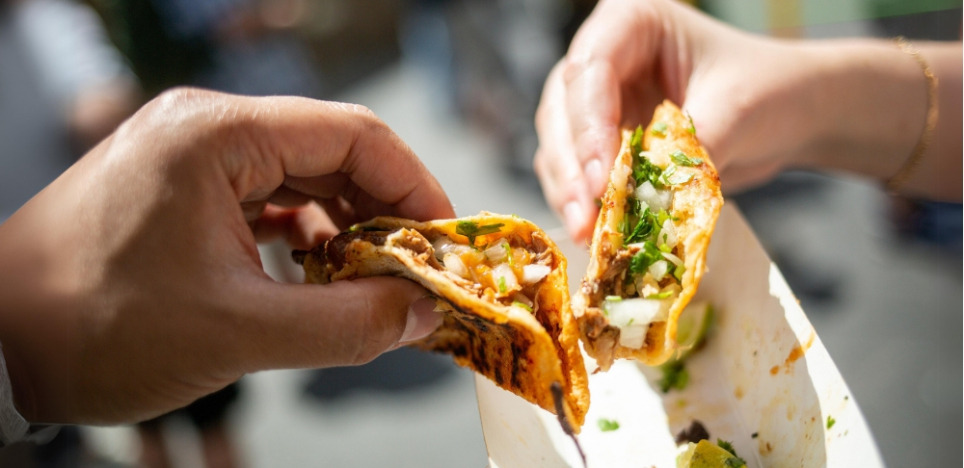
So: What do you like in your tacos?
- See more Spiritual Resources for the U.S. Election Year.
- To receive these weekly features in your inbox on Mondays, subscribe to the Practicing Democracy Project email list here.