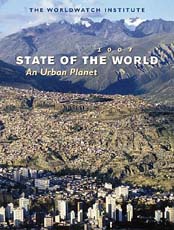
"Sometime in 2008, the world will cross an invisible but momentous milestone: the point at which more than half the people on the planet — roughly 3.2 billion human beings — live in cities. The combined impact of a growing population and an unprecedented wave of migration from the countryside means that over 50 million people — equivalent to the population of France — are now added to the world's cities and suburbs each year. More than at any time in history, the future of our humanity, our economy, and the planet that supports us will be determined in the world's cities."
This is the view of Christopher Flavin, President of Worldwatch Institute, based upon research for this edition of their annual report on the condition of the planet and its people. Urban centers around the globe are centers of phenomenal economic and artistic activity while at the same time they house millions of poor people in slums. Some cities are pioneering new environmental options, but many others are centers of terrible industrial pollution and resource destruction. One of the biggest revelations in this eye-opening report is that the growing urbanization of the world is leading us to rediscover nature and the ecosystem treasures that determine the quality of life.
Here are some statistics from the reports in this paperback:
• In 1950, only New York and Tokyo had populations of more than 10 million. Today, there are 20 of these so-called megacities, the bulk of them in Asia and Latin America.
• Of the three billion urban dwellers today, it is estimated that one billion are slum dwellers. What is worse, if we continue with business are usual, that figure is set to double by 2030.
• Over one quarter of urban residents in the developing world — more than half a billion people — lack clean water and sanitation, and 1.6 million die each year as a result.
This edition of State of the World edited by Linda Starke contains a treasure trove of information and ideas on water and sanitation, urban farming, local energy production, "green" transportation options, disaster preparedness, and local economic stability, along with snapshots of cities from Timbuktu to Los Angeles. Best of all are descriptions of innovative urban programs which bode well for the future of cities. Reading this "State of the World" report will enable you to see that we all bear a responsibility for nurturing the cities of tomorrow by the way we live today. Equally important is that we bring the same reverence to the urban environment that we bring to the great outdoors and wilderness areas.