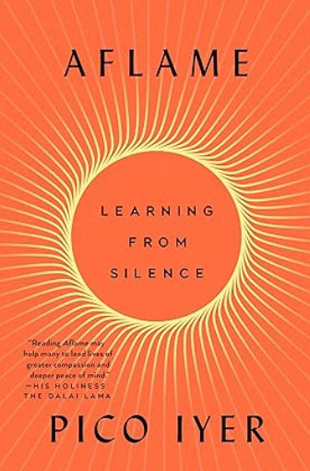
Pico Iyer has written many books, including one about his friend H.H. the Dalai Lama (who writes a prominent endorsement of this one) and another that we loved a decade ago called The Art of Stillness, which began as a TED Talk viewed by millions of people. That book reminds us of this one. First, Iyer wove memoir and personal experiences of slowing down; here, he does the same about being quiet.
With spirituality that’s often somewhat Buddhist or Christian, Iyer’s books also show how and where the two come together around common themes and priorities. He doesn’t advocate any religious tradition, but explains: “I’ve never wanted to be part of any group of believers. The globe is too wide, too various, to assume one knows it all.” But in this book, his experiments with silence take place at a Catholic monastery in Big Sur, California where he’s been spending regular time for decades.
(For the author’s definition of God, see the excerpt accompanying this review.)
Iyer reveals that inner work is important for so many people because it leads to heightened attention to love, wonder, and paying attention. For example, in chapter 2 he writes this, after revealing the long periods of time he spends in silence, alone at the monastery:
“In the solitude of my cell, I often feel closer to the people I care for than when they’re in the same room, reminded in the sharpest way of why I love them; in silence, all the unmet strangers across the property come to feel like friends, joined at the root. When we pass one another on the road, we say very little, but it’s all we don’t say that we share.”
Later on, he tells us: “Contemplation, I come to see, does not in any case mean closing your eyes so much as opening them, to the glory of everything around you. Coming to your senses, by getting out of your head.”
There are many accounts of conversations with monks, and personal experiences that show how a life can weave in and out of the way that monks do things. This is a beautiful spiritual memoir. And Pico Iyer is the ideal guide into silence for the religion-weary or wary, showing that religion (still) works beautifully when it helps us become people of spiritual practice.