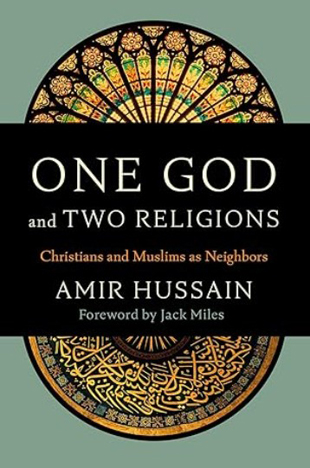
This book aims to educate Christians to see and understand their Muslim neighbors and their Islamic faith and practices. The author is Muslim and a professor of theological studies at a Catholic university. He writes at the outset that “the relationship between Islam and Christianity, and more importantly between Muslims and Christians, are important to me.”
Part One introduces Muslims and Islam with examples of the immigrant experience, including his own: “I was born in Pakistan and immigrated to Canada with my family when I was four.” But he also explains that Islam is not only a faith of immigrants in North America; there are many who convert to the faith, as well. For example, the author explains: “Muslims do not see Islam as a new religion, introduced to the world after Judaism and Christianity. Instead, they see it as the primordial religion of God’s creation.”
Then comes a chapter on the Prophet Muhammad, a chapter on the Qur’an, and a chapter on Muslim faith and life called “Surrender to God,” which is a central spiritual theme.
“I have written this book for Christians,” Amir Hussain explains more than once. So in Part Two he focuses on “Issues for Dialogue” including “Violence and Jihad,” “Roles of Women and Men,” and “Sufism” — the mystical tradition “that cuts across divisions within Islam” (chapters 5-7).
A concluding chapter explains in more detail how Muslims understand and practice their religion and how they seek to coexist with Christians. There are sections on what Muslims can learn from Christians, and what Christians can learn from Muslims. Along the way, Hussain offers a tribute to the religion scholar, Wilfred Cantwell Smith (d. 2000). Smith was both an ordained Presbyterian pastor and, according to Hussain, both “blessed” and “the greatest North American scholar of Islam.” Smith demonstrated the importance of understanding faith not as a series of propositions, or a monolithic tradition, but as living and vital in real people.