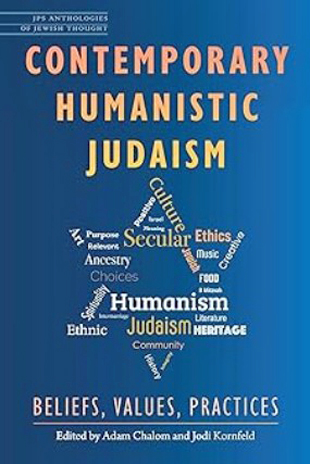
This is a primer of sources and an introduction to a growing segment of Jewish practice. Whereas the large mainstream liberal Jewish denominations (or “movements,” as they are often called) still use frequent God language, Humanistic Jews by definition do not.
As the Introduction states, “Humanistic Jews emphasize human power and responsibility rather than divine authority.” This is true in my experience in liberal mainstream Jewish congregations as well; the difference is that in Reform, Reconstructionist, and Jewish Renewal congregations, the language of prayer to God and God’s actions in the world is still prevalent. Their prayer books are full of such language, whether or not it reflects the beliefs of those praying the words. It’s tradition.
Humanistic Judaism sets out to recapture the nontheistic side of Jewish tradition, fostering a “secular Jewish community” which they feel mirrors a large segment of the Jewish population. This “blends an explicitly human-focused and naturalistic philosophy of life with cultural Jewish identity, celebrations, and community.”
An Introduction traces the origin and growth of this movement, followed by four parts each with multiple contributors writing on these broad topics: Belief and Ethics, Identity, Culture, and Jewish Life.
Some familiar names and literary “stars” appear here, for instance Marcia Falk writing about liturgy in “Honoring Torah” and Nathan Englander on the cultural Jewish canon with “What We Talk About When We Talk About Anne Frank.”
We found the final chapter of Part Four, on “Education,” particularly interesting and revealing — on ways to treasure the legacy of Jewish legends, wisdom teachers, stories, language (Hebrew and Yiddish both), commandments, and Torah study with a healthy and productive secularism.