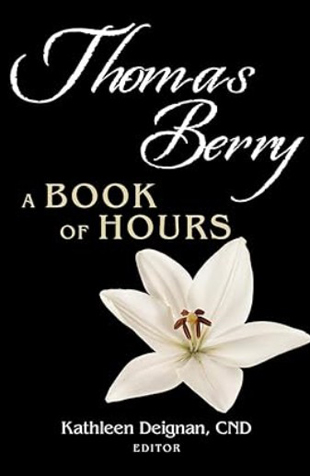
This is another gem in what has become a series of “books of hours” with great spiritual teachers of the late twentieth century. We awarded the one devoted to Thomas Merton as a “Best Spiritual Book of the Year” in 2007. We similarly awarded the one devoted to Teilhard de Chardin in 2023. What a delight it is to see Thomas Berry so quickly on the heels of de Chardin!
Kathleen Deignan has also taught an e-course for us on Thomas Berry, which is still available.
Thomas Berry (1914-2009) was a Passionist priest, cultural historian, and religion scholar who called himself a “geologian” rather than theologian. He was founding director of the Riverdale Center for Religious Research, and co-founder of the American Teilhard Association and Green Mountain Monastery in Greensboro, Vermont.
A “book of hours,” or breviary (as it’s often called) is a medieval idea that Kathleen Deignan has deftly brought into the present as a way of reframing the writings of these mystics as daily companions. She shows, through editorial skill and creativity of presentation how the very modern ideas of someone like Thomas Berry are a part of perennial wisdom — and even prayer. A book of hours is for prayer and contemplation and, as Deignan explains: “Thomas Berry never composed a breviary…. Though Thomas never wrote prayers or psalms per se, it has been a protracted interval of grace for me to discover in the richness of his written legacy, a trove of glorious hymns, canticles, litanies, and blessings to revive our Ecozoan soul and senses.”
The book is designed for close and intensive contemplative use for a period of eight days — from a Sunday to a Sunday, with Berry’s writings presented anew as prayers, hymns, and readings (that word is used here in the way one encounters it in church when “readings” from scripture are done aloud in the congregation) for four moments of each of the eight days at Dawn, Day, Dusk, and Dark.
To that end, the writings are reframed into these devotional and contemplative forms most often with simple changes to the line breaks, presenting them as psalm-like or poem-like versions of what originally were simply sentences. For example:
The universe is
the primary revelation of the divine,
the primary scripture,
the primary locus of divine-human communion.
Essential themes of Thomas Berry’s work are all here: grasping our place in the Earth community and as humble parts of the Universe’s story, most of all. Or, as Deignan puts it in her introduction, this is the story “of our cosmos as epic, as prophecy, as gospel.”
Go Deeper:
Thomas Berry, Prophet and Mystic of the Earth: This e-course draws out the contemplative depth and call to practice in Berry's works.