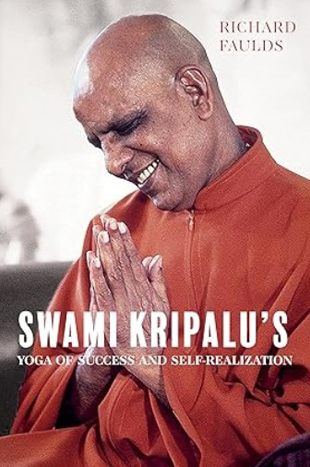
This is the most thorough presentation we’ve seen of Swami Kripalu’s teachings, practices, and stories. The author is a longtime student, with close associations to the Kripalu Center for Yoga and Health in Massachusetts, founded to carry those teachings and practices forward. The Swami passed in 1981.
Faulds’ approach is one of reverence toward his subject, but he’s also able at times to point where the teachings have continued to be developed and interpreted.
It is a big book of 340 or so packed pages, perhaps as much as 30 percent of which is quotations, well-chosen, from Swami Kripalu himself. One of the three appendices is 30 pages of “teaching stories” frequently used by the Swami, such as “The Tax Collector and the Mahatma.”
“I encourage all my householder students, telling them: Establish yourself like a sun in the solar system of society,” said Swami Kripalu, quoted by Faulds at the start. Faulds makes it clear that his is a presentation of the practices to be embraced by “householders” — ordinary people with partners, jobs, children, mortgages, rather than monks. For them, is the promise of the title: yoga, success, and self-realization. The three are intentionally connected.
In keeping with this, there are teachings revealing the well-rounded people that Swami Kripalu set out to create. Chapter 17, for example, is devoted to “Character Building” and the first of nine principles of this, according to Faulds’ summary, is “Commit to looking only at your own character.” Others include, “Be sure to also acknowledge your good qualities.” And principle nine of character building is a frequent theme, always, in this book that aims to summarize and introduce Swami Kripalu’s legacy for those who will never have the chance to sit with him in person: “Continue your on-the-mat yoga and meditation practice.”
Warm photographs of the Swami appear on these pages, as do graphs, even one original cartoon. One graph illustrates “the journey of self-development,” which in many ways could summarize the book as a whole, with five concentric circles, the center being “true self,” and the others, in order of proximity to the center: “ecstatic self, authentic or empathetic self, egocentric self, primal self, and biological self.” This is part of Faulds’ summarization of “The Five Sheaths or Koshas of the Soul,” after scrutinizing his teacher’s commentary on the Hatha Yoga Pradipika and the Taittiriya Upanishad.
This is a book for serious students, and given the richness of what’s being offered, one imagines that many new serious students for Swami Kripalu’s wisdom will be found.