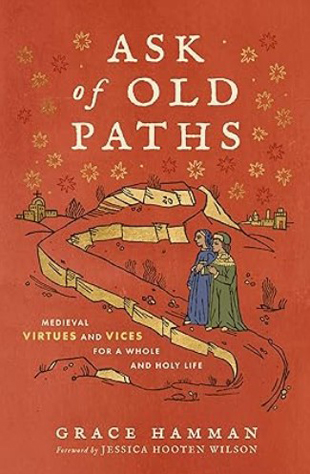
This author and publisher come from the more conservative side of Christianity, but their book aims to bring people together around something more important than politics or the current cultural divide. In a preface under the heading, “Why we need the language of the virtues,” Grace Hamman confesses that “the modern language of the virtues [may feel] more like dying potted plants than the wild, breathing garden it was in the Middle Ages.” Then, she explains, the virtues — in contrast to “values language” — are able to unite us across our habitual divides:
“Values binaries erase the complexities of life together and of nuances in position,” she writes, as it often goes directly to who is “good” and who is “bad,” based on an opinion or stance. Moreover, “While proclaiming my values, I can virtue-signal what team I am on without changing any behavior.” This is very true and it probably happens on social media every second of every day.
It is in this context that we welcome this discussion of virtues. As Hamman explains: “In contrast [to 'values'], real virtues concern the habitual actions of a real person, a moral agent.”
Each of the seven traditional virtues and their corresponding vices, according to historical Christian tradition, are examined in detail in a twenty-first century vein. Hamman never simply assumes that the medieval explanations are helpful. She confesses, for instance, “I winced more than once as I typed that list” — referring to the seven vices. Gluttony is one of those seven, and Hamman writes: “What person grappling with body image issues hears 'gluttony' without a sinking dread?” So, she traverses this ground sympathetically and thoughtfully as an intellectual with a Christian heart.
Seven chapters on vices and virtues are framed in interesting ways, often with juxtapositions that give fresh meaning to old ideas: “Pride and Humility,” “Envy and Love,” “Wrath and Meekness,” “Sloth and Fortitude,” “Avarice and Mercy,” “Gluttony and Abstinence,” and “Lust and Chastity.” Quotes from medieval theologians and mystics are used throughout, as well as Protestant and Catholic thinkers from the last century and other essential moral agent-thinkers such as Martin Luther King, Jr.
Each chapter includes a bullet list of suggested practices of that virtue and a paragraph prayer for stating an intention to become an intentional moral agent in this area of life.
Finally, the book has a lovely look and feel. Several black-and-white illustrations from period paintings and religious scenes from medieval manuscript illuminations are placed throughout the book, giving it a suitable ancient-modern feel.